For hostage rescue missions, the Penetrating Imager’s through-window observation capability promises a clear view, yet the reality is often far from straightforward. In real operations, a hostage taker inside a vehicle or a room with windows presents an extreme challenge for tactical teams. Exterior glass surfaces reflect ambient light, many windows are tinted or laminated, and interior lighting is often poor or deliberately obscured. A patrol officer or entry team member standing outside may see only a distorted mirror image instead of the people inside. This lack of visual intelligence forces rescue personnel to move closer, exposing themselves to gunfire, or to make blind entries that can escalate violence. The Penetrating Imager changes that equation because it provides true through-window observation in conditions where the naked eye and conventional optics fail. Assessing the situation from a safe standoff distance before any forced entry becomes the difference between a controlled rescue and a lethal gamble. Without such imaging capability, teams must rely on audio clues or risky verbal negotiation, which are incomplete at best. The Penetrating Imager directly addresses this reconnaissance gap.
The core technology behind the Penetrating Imager relies on laser range-gated imaging, also known as gated imaging. The system consists of a high-repetition-rate pulsed laser, an image intensifier gated camera (with MCP image intensifier, high-voltage module, timing module), a beam expander, and an imaging lens. A pulsed laser illuminates the target scene, while the gated camera opens its shutter only for the brief moment when light from the desired distance arrives. This suppresses backscatter from the window surface and surrounding atmosphere, allowing the optical system to capture objects through automotive glass, airplane portholes, or glass curtain walls. Because the imager is an active system, it works in complete darkness and in conditions of strong glare. For rescue teams, this capability transforms a reflective pane of glass into a transparent observation port. The precise timing control rejects the glare that would otherwise saturate a conventional camera, and the high-resolution output provides a clear, high-contrast image of the interior. This makes the device an essential tool for covert through-glass recon without any physical contact or alteration of the window. Unlike passive optics, the system generates its own illumination, so the rescue team does not depend on available light or compromise its position.
In a typical hostage rescue scenario involving a vehicle, an operator takes position behind cover at an optimal standoff distance. The Penetrating Imager is aimed at the side window or windshield. With the touch of a button, the pulsed laser fires and the gated camera receives reflected light from the interior surfaces, while the glass reflection is discarded in time. Within seconds, the operator observes the positions of the hostage and the perpetrator, their movements, and whether any weapon is visible. The device also sees through moderately tinted vehicle glazing, which is common in civilian and criminal contexts. This information is transmitted to the command post through a video link, enabling the entire team to coordinate the rescue without a single direct glance through the window. The operational flow is simple: deploy, aim, observe, and report. Because no contact with the window is required, there is no risk of alerting the subject by tapping or breaking glass. The through-window tactical observation can be maintained continuously during negotiation, providing live updates as the situation evolves.
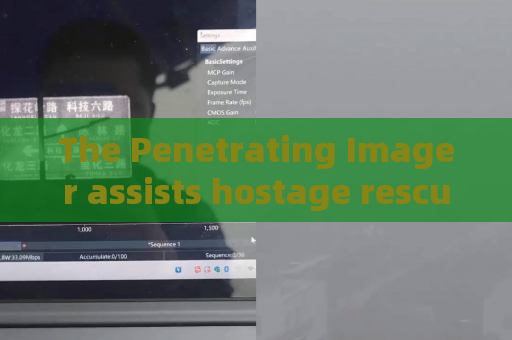
The detailed imagery from the Penetrating Imager remains stable even when the scene includes smoke, light fog, or rain, as the range-gating technique avoids most scattering effects. For hostage rescue in a parking garage or near glass facades, this reliability is critical. The system’s handling of bright sunlight or artificial floodlights prevents the blown-out frames that would hide a subject inside a car. In low-light environments, the active laser illumination produces clear images without requiring an infrared illuminator or a night-vision device. Every slight change inside the vehicle—the raising of a hand, the shifting of a gun muzzle, the constant motion of a hostage—is visible through the imager’s high-contrast output. This continuous feed sharpens situational awareness for snipers, entry teams, and negotiators alike. The Penetrating Imager has thus become a decisive asset for hostage rescue units, turning a sealed glass barrier into an information advantage that protects both rescuers and those they are sent to save.




