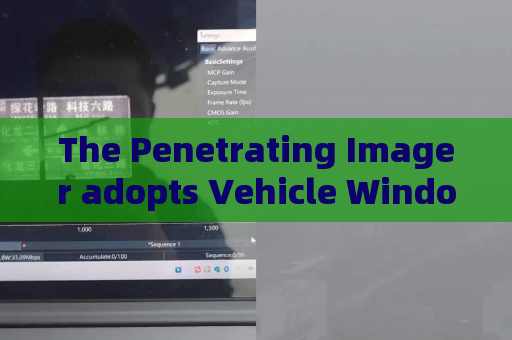
The Penetrating Imager adopts Vehicle Window Penetration to enhance safety during long-distance border patrol operations Long-distance border patrol operations demand a careful balance between maintaining a safe standoff distance and acquiring actionable intelligence about suspicious vehicles. A stationary car parked along a remote crossing may appear abandoned, yet the threat inside remains concealed by tinted glass, reflective coatings, or dashboard glare. The patrol team often observes a vehicle for minutes or even hours from a distance, but conventional optics fail to reveal what is happening in the cabin. Binoculars and spotting scopes cannot defeat the reflections from the windshield or the dark privacy film on the side windows. Approaching to verify occupancy exposes personnel to ambushes, explosive devices, or hostile fire. In a region where communication delays and rocky terrain make cover slow, every meter gained toward an unknown car increases the risk. The Penetrating Imager addresses this fundamental dilemma by allowing operators to inspect the vehicle interior without closing the distance. The challenge is not merely seeing through a window; it is doing so at range, in daylight or darkness, while preserving the tactical advantage of surprise and preventing an unnecessary escalation. The Penetrating Imager employs laser range-gated imaging, a form of active optical sensing that synchronizes a pulsed laser with a gated camera. Only light reflected from a selected distance window is captured, which suppresses backscatter from rain, dust, fog, or atmospheric haze. When aimed at a car window, this technology achieves Vehicle Window Penetration, rendering the glass virtually transparent to the imaging system. Operators can perform a through-window tactical observation of the cabin, seeing occupants, hands, objects on seats, or suspicious wiring. The system works through automotive glass, tinted films, and even under low-light or zero-light conditions because the laser provides its own illumination. Unlike passive imagers that depend on ambient light, the range-gated design captures a clean reflection from the target plane, eliminating the interfering reflections that bounce off the glass surface itself. This distinction matters in border operations, where a suspect vehicle may have heavily tinted rear windows that normally hide the number and actions of passengers. The laser pulse travels to the cabin and back within nanoseconds, and the camera's gate opens only for that precise moment, so the resulting image shows the interior rather than the windshield glare or dirt. This gated viewing principle is what separates the Penetrating Imager from ordinary cameras, giving patrol teams a new layer of optical access. Deployed from a patrol vehicle or a fixed observation point, the Penetrating Imager provides real-time imagery to the officer at a safe distance. A standard operation might involve stopping a suspect vehicle at a checkpoint while the system scans from 30 to 100 meters away. The long effective range and high resolution enable the operator to distinguish a driver reaching for a firearm from one simply producing documents. Because the system is active and insensitive to ambient lighting, it performs equally well under harsh sunlight, deep shadow, or complete darkness. During a long-distance border patrol, the imager can be mounted on a tripod behind a ridgeline, allowing the team to monitor an approaching vehicle without being detected. The operator watches the screen and communicates through discreet hand signals when necessary. Each scan can be repeated to verify sudden movements, such as a passenger leaning forward or an arm sliding beneath the seat. The risk of escalation drops because the team already knows whether the occupants are armed, hostile, or merely frightened. This capability transforms a routine traffic stop into a controlled tactical event, reducing the need for flashlight sweeps or the dangerous practice of tapping on glass. For long-distance border patrol teams, the Penetrating Imager turns a static observation point into a proactive security tool. Instead of relying on verbal challenges or physical approach, officers maintain visual access to the vehicle's interior throughout the entire engagement. The range-gated technology also suppresses the blinding reflections from headlights or a low sun, providing a clear image when conventional optics fail. With each scan, the unit confirms the number of occupants, their behavior, and the presence of potential threats. The system's resistance to backscatter proves valuable in dusty conditions along the border, where airborne particles often wash out ordinary telescope views. Even rain or snow between the imager and the car does not prevent identification, because the selected-range gate rejects scattered light from the precipitation. For a patrol team covering hundreds of kilometers, this means a suspect vehicle can be assessed from a safe vantage point before any decision to approach, arrest, or call for backup. The system ultimately raises the safety threshold for every patrol, allowing informed decisions from a position of strength. Vehicle Window Penetration is not just a technical feature; it is a protective barrier between the unknown and the officer.




