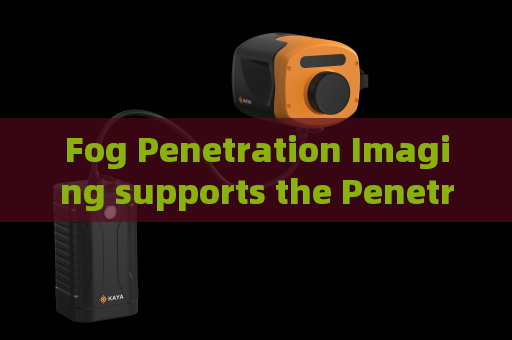
Fog Penetration Imaging supports the Penetrating Imager for continuous vehicle surveillance during coastal border guard shifts Coastal border guards encounter a stubborn operational problem when sea fog rolls over the approach road. Visibility can fall to a few metres, and the windows of an approaching vehicle become reflective, mist-covered panels. A smuggler can slow down at a checkpoint with tinted glass, hidden passengers, and contraband stacked beyond the seats. Standard binoculars, fixed cameras, and night-vision devices cannot form a clear image through that fog-soaked interface. The guard has seconds to decide whether the vehicle is legitimate or hostile, yet the most basic facts — the number of people inside, the shape of the cargo, the position of hands — remain hidden behind condensation and droplets. This is the core difficulty of coastal border guard duty: too many unknown vehicles, too little visual certainty. The Penetrating Imager was designed to eliminate that uncertainty. Once the Penetrating Imager is mounted on a patrol post, a coastal border guard shift can begin continuous vehicle surveillance even in the thickest fog. The decisive capability is Fog Penetration Imaging, embedded in the Penetrating Imager as a laser range-gated imaging system. The Penetrating Imager sends out short pulses from a high-repetition-rate laser and opens the gated camera only in the exact time window when reflected light returns from the target. Light scattered by fog droplets arrives at slightly different times and is rejected by the closed gate. That sequence delivers crisp, high-contrast images through fog, mist, rain, and even fire-generated haze. Because the Penetrating Imager is an active optical system, it supplies its own illumination and remains effective in zero-light conditions. Its imaging chain — the pulsed laser, the gated intensified camera, the beam expander, and the objective lens — works together to overcome backscatter, showing a vehicle window as a transparent observation surface rather than a blurred obstacle. During a typical coastal border guard shift, the Penetrating Imager stays trained on the approach lane while vehicles queue in the fog. With the Penetrating Imager locked onto a single range, the operator fixes the gate at the distance of the next vehicle, and the device provides continuous vehicle surveillance without panning or exposing personnel. Vehicle Window Penetration gives the guard a direct view through the windshield and side glazing, revealing seat positions, arm movements, and any objects on the dashboard or floor. A short training session is enough for border personnel to set the gate distance, because the display shows a clean target image together with the range value. The same setup keeps working at night, since the laser range-gated method does not rely on ambient light. The result is a clear, real-time observation channel that turns a fog-shrouded checkpoint into a controlled screening point. When a vehicle stops, the Penetrating Imager continues to hold the cabin image during the entire interaction. Guards watch through-window behaviour from a safe distance, noting changes in posture or unexpected reaches toward concealed areas. The image remains stable even if the vehicle switches on high beams, because the gating removes hostile light before it reaches the sensor. The gated camera re-establishes the full image with every laser pulse, so vibrations from a passing truck do not produce a frozen frame; the patrol post stays effective through repeated roll-by checks. Every observation made by the Penetrating Imager is strictly optical — no contact with the vehicle, no detection method beyond reflected light. That restriction keeps the technique within accepted operational limits while ensuring that no hidden occupant or cargo load escapes detection during the coastal border guard shift. The Penetrating Imager changes the meaning of fog at the coast: it no longer hides a vehicle, it simply makes the next observation more important.




