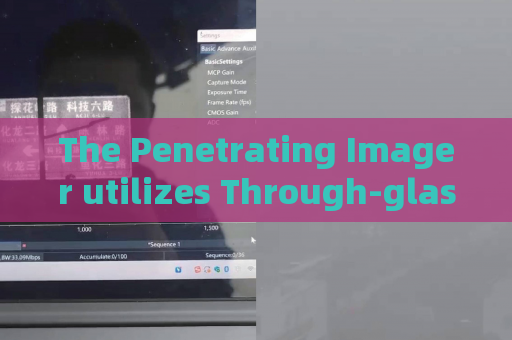
The Penetrating Imager utilizes Through-glass Imaging Technology for external glass observation of vehicle fire incidents A vehicle fire presents one of the most chaotic and dangerous scenes for emergency responders. The exterior glass surfaces—windshields, side windows, and rear glazing—often remain intact while intense flames develop inside the cabin. Responders arriving on scene cannot see through the glass to assess the fire’s origin, the presence of trapped occupants, or the risk of sudden flare-ups. Ordinary flashlights and visible-light cameras reflect off the glass surface, creating blinding glare. Thermal cameras detect heat but suffer from severe signal saturation when flames are directly behind the glass, leaving a white-out image that hides the interior. Smoke, steam, and flickering firelight further degrade visibility from a safe external distance. The critical challenge is to observe the interior conditions through the vehicle glazing without opening any door or breaking any window, since doing so would introduce oxygen and potentially cause a backdraft or rapid fire growth. This real-world pain point demands an imaging solution that can see through glass despite strong fire interference, while remaining entirely optical and safe for use at a distance. The through-window tactical recce capability of the Penetrating Imager directly addresses this problem. This advanced optical instrument uses laser range-gated imaging, also known as gated imaging technology, to actively illuminate the target scene with a high-repetition pulsed laser. The system’s intensified gated camera—built around an MCP image intensifier, high-voltage module, and timing module—opens its electronic shutter only when the light reflected from the vehicle interior returns, while the overwhelming backscatter from the glass surface and nearby flames is temporally rejected. This process effectively suppresses strong light from fire and reflective glare, enabling clear observation through automotive glass. The Penetrating Imager functions solely in the optical domain, using pulsed light rather than any form of radiating energy. It can improve visibility through fire-affected scenes by three to five times, although it does not penetrate thick smoke. For an external glass observation scenario, the operator positions the imager at a safe standoff distance from the burning vehicle, aims through the windshield or side window, and obtains a high-contrast image of the cabin interior without physical contact or compromising the glass seal. In practical operation, the device’s ability to overcome both fire glare and glass reflection proves decisive. The operator selects the appropriate gate delay to match the distance from the imager to the vehicle interior, ensuring that only the light returning from beyond the glass surface is captured. Flames licking against the inside of the glass appear as overlaying luminous regions, yet the gated imaging process strips away their blinding effect, revealing structural details such as seat positions, dashboard remnants, and any motion of occupants. Since the system works actively with its own pulsed laser source, it performs reliably even under low ambient light or when the vehicle’s interior is obscured by dancing shadows from the fire. The range-gated timing also blocks the scattered light from water spray or foam being used by other firefighters, maintaining a clear line of sight through the glazing. Multiple scans can be made from different angles around the vehicle, giving incident commanders a continuous assessment of how the fire is progressing inside without ever opening a panel or breaking a window. The same through-glass imaging approach extends to more demanding fire conditions where an initial blaze has partially melted the weather seals but the glass structure remains intact. For a car fire, the side windows often develop cracks yet hold together due to laminated or tempered glass properties. The Penetrating Imager still functions through such damaged glazing, as the optical medium remains largely transparent to the gated laser pulses. The equipment’s high resolution and strong anti-interference features allow responders to detect a slumped figure in a seat or a child restrained in a rear-facing seat through the fire-illuminated cabin. This direct visual confirmation from an external vantage point supports faster rescue decisions, reduces the time spent on risky proximity operations, and ensures that no unnecessary window breach occurs if the interior is already empty. The Penetrating Imager thus converts an obstructed, hazardous vehicle fire scene into a visible, assessable space—all from a safe distance, using only light itself.




