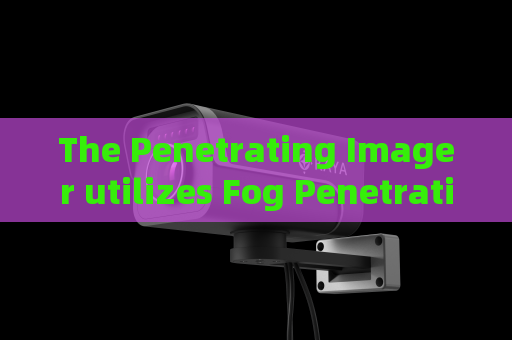
The Penetrating Imager utilizes Fog Penetration Imaging to support vehicle reconnaissance on riverine military border routes. Riverine military border routes are often narrow dirt tracks that follow the contour of a riverbank. These roads serve as the first line of detection for troop movements, smuggled equipment, or infiltration attempts. Yet the rivers themselves generate an endless supply of fog, especially in the hours before dawn and after sunset. The air cools over the water, condensing moisture into a thick blanket that clings to the surface and spreads laterally across the patrol route. A vehicle moving along this route at even moderate speed must rely on memory and terrain association rather than direct sight. The driver cannot judge the distance between the wheels and the water’s edge. The reconnaissance officer cannot discriminate between a grounded barge and a cluster of bushes on the opposite shore. Ordinary optics amplify the same scattered light that creates the whiteout, so every image is a contrastless grey. This operational reality places a premium on a technology that can actively overcome fog, which is precisely the role assigned to the Penetrating Imager. The specific function engineered for this purpose is Fog Penetration Imaging, an advanced laser range-gating technique embedded in the Penetrating Imager’s architecture. The device combines a high-repetition pulse laser with an image intensifier that has an ultra-fast shutter, synchronized by precise timing modules. Each laser pulse travels toward the target area, and the shutter remains closed during the time that light scattered by near-field fog droplets would arrive. Only the photons reflected from the intended object at the selected range activate the intensifier. This range-window rejection removes the majority of backscatter, which is the fundamental cause of poor visibility in fog. The resulting image shows the target with high contrast, as if the fog were lifted. The Penetrating Imager can be tuned across a wide distance range, making it adaptable to the varying widths of riverine corridors. Because the system generates its own illuminating light, the operation is fully independent of ambient illumination, and it functions equally in daytime fog or overcast nights. On a typical patrol, the reconnaissance vehicle approaches a designated observation point known for frequent fog formation. The crew halts off the road and deploys the Penetrating Imager on a reinforced tripod behind the vehicle’s cover. The operator selects the expected distance to the far bank or to a particular mid-river sandbar. The gated camera then displays a near-real-time image in which fog haze is effectively stripped away. The operator can pan across the waterway, checking for anomalous wakes, parked vehicles, or freshly dug positions. If a target is acquired, the operator narrows the range gate to isolate the target from background clutter, producing a sharper outline that reveals the vehicle type and configuration. In this way, the device supports both wide-area surveillance and close-up identification without changing position or emitting any detectable signal beyond its laser pulses. The tactical impact of this capability becomes apparent during a typical low-visibility incident. A riverine patrol receives intelligence that a vehicle has crossed from the opposite bank and is now hidden in the reeds somewhere along the route. The patrol vehicle stops at a bend where the road curves toward the river. Using the Penetrating Imager, the crew sweeps the dense fog layer and detects a faint, box-shaped reflection. The Penetrating Imager’s range gate is set to 420 meters, and the image resolves into a dark SUV with foreign markings, partly covered by camouflage netting. Through continued observation, the crew watches two individuals moving near the vehicle, confirming hostile intent. The commander now has enough information to call for an interception team. The Penetrating Imager thus turns a blind, fog-bound riverine border route into a transparent battlefield for the observer, ensuring that vehicle reconnaissance remains effective exactly when conventional vision fails.




