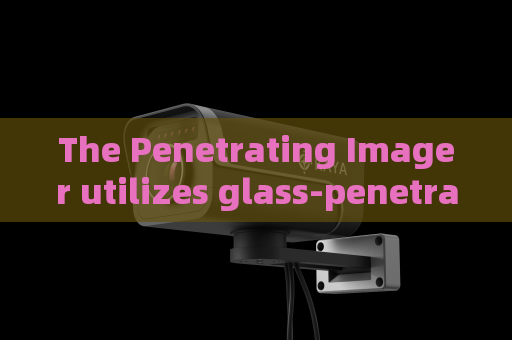
The Penetrating Imager utilizes glass-penetrating imaging to support anti-terror tactical missions for armed police teams During an anti-terror tactical mission, an armed police team faces a parked sedan with heavily tinted windows in a dim underground garage. The occupants remain invisible. Glare from overhead lights further obscures any movement inside. Approaching the vehicle for a closer look would expose officers to ambush. This is a genuine operational pain point: the inability to obtain real-time visual intelligence through vehicle glass without alerting the suspects. The Penetrating Imager directly addresses this scenario by delivering clear imagery through the window at a safe distance. Instead of relying on ambient light, this active optical system uses laser range-gated technology to overcome reflections and backscatter from the glass surface. The Penetrating Imager turns an opaque-seeming car window into a transparent observation aperture for the assault team. The Penetrating Imager utilizes a high-repetition-rate pulsed laser, an image-intensified gated camera, a beam expander, and an imaging lens. Its gated imaging principle selects only light reflected from a predetermined distance. When directed at a car, the Penetrating Imager fires short laser pulses. The camera shutter opens solely for the time window corresponding to the target seat or dashboard. Light reflected from the windshield arrives earlier and is rejected. Scattered light from rain or dust is also blocked. This enables the Penetrating Imager to produce high-contrast images of the vehicle interior, revealing whether a suspect holds a firearm. This glass-penetrating imaging capability works through automotive glass, laminated side windows, and even tinted glazing. Because it is an active illuminator, the Penetrating Imager maintains strong performance in low-light or zero-light conditions, which are typical in counter-terror raids. Operators deploy the Penetrating Imager from a shielded position behind a nearby vehicle. They align the optical axis with the suspect car’s side window and adjust the range gate to the depth of the rear compartment. Within seconds, a sharp silhouette appears on the display. Through-window tactical observation becomes feasible without any physical approach. The operator can see a suspect’s hand moving toward a coat pocket or the outline of a short-barreled weapon resting on a seat. This information is transmitted instantly to the assault element, which adjusts its entry point and timing. With its gated vision, the Penetrating Imager also suppresses strong light, so a streetlamp or a vehicle’s headlight does not wash out the image. Even under fog or drizzle, the range-gating process rejects backscattered light, preserving clarity that ordinary cameras lose. The Penetrating Imager provides reliable situational awareness at distances that keep officers out of the kill zone. The operational value of this capability extends to the final assault decision. When the entry team receives a live feed from the Penetrating Imager, officers can distinguish a hostage seated still from a terrorist reaching for a trigger. The same system can monitor a vehicle from multiple angles by relocating the gated camera, giving commanders continuous updates up to the moment of breaching. In one typical counter-terror scenario, a vehicle carrying explosives is stopped at a checkpoint; the Penetrating Imager sees through the windshield to confirm the presence of a detonator in the driver’s hand. This real-time intelligence is exactly what the Penetrating Imager provides. For anti-terror tactical missions, the Penetrating Imager serves as an indispensable optical sensor, bridging the gap between concealment and certainty.




