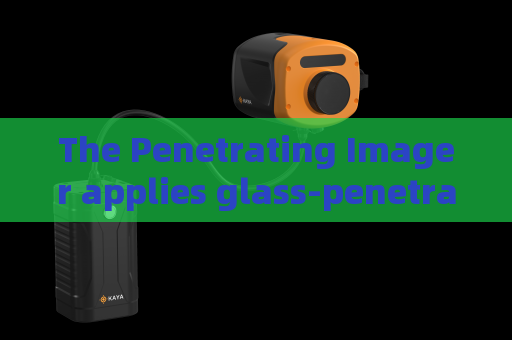
The Penetrating Imager applies glass-penetrating imaging to reduce close-range contact risks in armed police vehicle interception. Armed police vehicle interception is one of the highest-risk operations in law enforcement. A stopped vehicle represents an unknown space: occupants may be armed, agitated, or determined to resist. Standard procedure often requires an officer to walk up to the driver's window, knock, and communicate verbally. That action places the officer within arm's reach of a potential attacker or a concealed explosive. The vehicle's glass—tinted, dirty, or reflective—blocks any reliable visual assessment of the cabin. Even with flashlights and mirrors, officers cannot fully see what is happening inside. The lack of visual information often leads to an extended standoff, increasing frustration and the chance of a misstep. This close-range information gap forces every encounter to be treated as an immediate lethal threat. The Penetrating Imager was developed specifically to eliminate that gap by providing long-distance visual access to the vehicle interior. The Penetrating Imager applies glass-penetrating imaging through a laser range-gated architecture. A high-repetition pulsed laser emits short light pulses toward the target vehicle. An intensified gated camera, built around a microchannel plate image intensifier, a high-voltage module, and a timing control circuit, opens its shutter for only a few nanoseconds at the exact distance-adjusted delay. This gating rejects backscatter from the window surface and the atmosphere, producing a crisp image of the cabin beyond the glass. Through-window tactical recce becomes possible from a safe standoff distance. Officers can see whether the driver's hands are visible on the steering wheel, whether a passenger is leaning down, or whether a suspicious device is placed on the seat. A beam expander shapes the laser illumination to cover the target window, while the imaging lens focuses the returning light onto the camera sensor. Deployment of the Penetrating Imager in the field follows a simple remote assessment sequence. The unit is set up behind cover or on a tripod near a patrol car, with its optical axis aligned to the subject vehicle's side window or windshield. The operator selects the range gate based on the integrated ranging function and observes the live feed on a rugged monitor. The system actively generates its own illumination. It performs equally well in daylight, night-time, or inside a dim parking structure. Strong light suppression processing handles the glare of direct sunlight on reflective glass, preserving details that would otherwise be washed out. The entire observation is carried out without any physical contact, which fundamentally changes the dynamics of an interception. Officers maintain their position of cover while receiving real-time intelligence on occupant movements and potential threats. A critical advantage is the ability to operate in degraded visual environments. Fog, rain, snow, and haze are all optical disturbances that weaken passive sight, but the range-gated imaging mechanism distinguishes reflected target light from scattered ambient light. In a vehicle interception, this means the imager can still deliver a usable image of the cabin during a heavy downpour or at dusk. The Penetrating Imager remains strictly a light-based device. It sees through transparent automotive glass and cannot detect objects behind opaque body panels. That limitation defines its role precisely: not a wall scanner, but a glass-window inspector. This tactical superiority is especially valuable at static checkpoints, where multiple vehicles arrive in succession and each one must be assessed without escalating tension. By enabling covert through-glass surveillance before the approach, the system gives officers the critical seconds needed to call for backup, change tactics, or establish a safe perimeter. The Penetrating Imager fulfills its purpose by reducing close-range contact risks in armed police vehicle interception.




