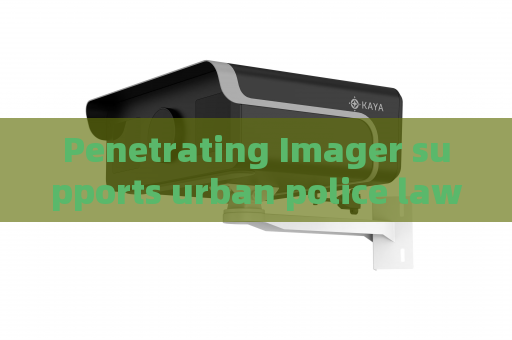
Penetrating Imager supports urban police law enforcement, utilizes glass-penetrating imaging to realize hidden danger detection. A routine vehicle stop remains one of the most unpredictable encounters in urban policing. A patrol officer approaches an unknown sedan with tinted windows, uncertain whether the occupant holds a license, a knife, or a firearm. Reflections on the curved glass surface, deep shadows in the cabin, and glare from oncoming headlights make visual assessment nearly impossible from any safe angle. The officer must decide within seconds whether to close in, call for backup, or take cover. This information gap at close range is precisely where hidden danger detection becomes a matter of life and death. Urban police departments need a method to see through automotive glazing from a standoff distance without alerting the occupant and without physical contact. The Penetrating Imager was developed for exactly this type of street-level confrontation, and its glass-penetrating imaging capability defines a new standard for pre-contact awareness. The Penetrating Imager directly addresses this operational gap without requiring officers to alter their established approach tactics. Built on laser range-gated imaging technology, the system combines a high-repetition pulse laser, an image-intensified gated camera with an MCP intensifier and internal timing modules, a beam expander, and a precision imaging lens. The Penetrating Imager emits short laser pulses toward the target vehicle and opens the gated camera only for the brief moment when reflected light from the chosen distance arrives back at the sensor. The range gate width can be narrowed to isolate a single seat plane, so the operator sees the occupant area without clutter from objects closer or farther away. Scattered light from rain, fog, mist, or the glass surface itself is rejected because it arrives outside the gate window. This active illumination approach delivers high-contrast images at ranges far beyond passive optical aids, with strong immunity to background interference. The see-through vehicle glass imaging mode produces a clear view of the cabin through windshields, side windows, and even heavily tinted automotive glass, while strong light suppression keeps headlights and street lamps from washing out the picture. In a high-risk traffic stop, the Penetrating Imager fits into the containment sequence without adding unnecessary exposure. The operator deploys the handheld unit from behind the cover of the patrol car door, or mounts it on a tripod at the rear quarter of the subject vehicle. A quick laser rangefinder reading sets the gate delay to match the distance to the target window, and the displayed image updates at near-video rate. A subject's hands, lap, and seat area become visible through the glazing, and a weapon on the floorboard or an occupant leaning forward out of view is recognized before any officer leaves cover. Because the near-infrared illumination is invisible to the eye, the observation remains covert. This covert through-glass observation gives the tactical team the complete picture of a suspicious vehicle approaching a checkpoint or a parked car matching a recent description, even when rain or mist degrades normal visibility. Operationally, the Penetrating Imager changes the risk calculus at every stage of a vehicle stop. Officers identify a hidden danger while still positioned behind hard cover, then approach with a clear picture of the occupant's posture, hand position, and immediate surroundings. The Penetrating Imager does not replace verbal commands, de-escalation tactics, or the judgment of the individual officer. It removes the blindfold that has always defined the approach to a stopped vehicle. When the unknown becomes visible before the contact distance closes, the officer keeps the initiative and the encounter follows a planned sequence rather than a reactive scramble. In this way, the Penetrating Imager gives urban police law enforcement a decisive advantage in one of the most common and most dangerous tasks on the street: seeing through the glass that hides a threat in plain sight.




