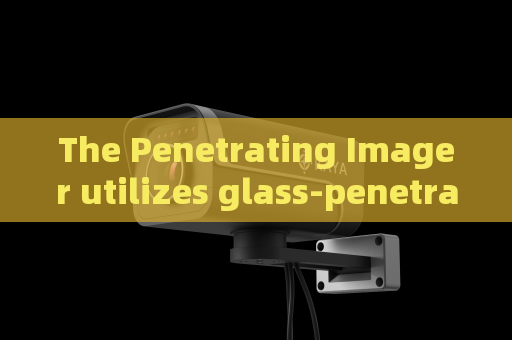
The Penetrating Imager utilizes glass-penetrating imaging to support anti-terror tactical missions for armed police teams Counter-terror operations frequently demand real-time visual confirmation of hostile activity inside vehicles, yet standard optical devices fail against automotive glass. Reflections from sunlight or street lamps turn a windshield into a mirror, while factory-tinted glazing can reduce visible light transmission to less than twenty percent. An armed police team tasked with confirming whether a suspected vehicle contains explosives or hostages faces a dangerous dilemma: moving closer for a better view risks alerting the occupants, while staying back with conventional binoculars yields nothing but glare and silhouette fragments. Even when the vehicle is stationary and the engine is off, the sheer contrast between the bright exterior and the darkened cabin defeats most cameras and night-vision tubes. This reconnaissance gap has long forced tactics to rely on thermal signatures or acoustic clues—neither of which can reveal a detonator wiring harness or a hostage’s restrained hands. The Penetrating Imager solves this specific problem through active laser range-gated imaging rather than passive light collection. Its pulsed laser illuminates the target zone with a narrow beam, while the intensified gated camera opens its electronic shutter only for the precise time it takes for reflected photons to return from the vehicle’s interior surfaces. By rejecting all light scattered from the windshield surface, the fog, or any intervening rain droplets, the system produces a high-contrast image of what sits behind the glass. For a tactical team conducting through-window tactical observation, the imager’s ability to suppress strong backscatter means a dirty, scratched, or heavily tinted SUV window no longer blocks the view. The operator sees the seat layout, the hands of every occupant, and any object resting on the center console—as long as the optical path is glass or another semi-transparent medium. No walls, no concrete, no fabric are imaged; the technology remains strictly within the realm of light, using a high-repetition-rate pulsed laser and a gated camera to isolate the desired depth plane. In practice, the Penetrating Imager is deployed from a discreet vantage point, often from a parked van or behind a low wall, with the optical head aimed at the suspect vehicle from fifty to one hundred meters away. The operator watches a ruggedized display that shows the cabin in near-daylight clarity. Because the system is active, it works equally well in deep shadow or at midnight, and it tolerates rain or snow flurries that would otherwise scatter light back into a conventional camera. A typical engagement begins with a wide scan to confirm the vehicle’s occupancy count, then switches to a narrow field of view to inspect a specific seat or footwell area. If the target vehicle turns or drives forward, the gating range adjusts in milliseconds, allowing continuous observation through side windows or a rear windshield without losing lock. This capability changes the tactical calculus: a team can verify the absence of a suicide vest and the presence of two hostiles before committing to entry, and they can do so without making any sound or visible movement. The same tool proves its worth during the final phase of an arrest operation, when officers must maintain a visual lock on a suspect who is rolling up a window or turning away from the door. With the Penetrating Imager, the aiming point for the breaching team remains clearly displayed through the glass, even as rain smears the exterior or as the suspect’s breath fogs the cabin side of the window. The device’s ability to overcome environmental optical interference—rain, mist, or bright sunlight—keeps the tactical picture uninterrupted. For armed police teams, this single function of glass-penetrating imaging transforms a blind corner into an open view, reducing risk and increasing the chance that a hostile situation ends without surprise. By providing clear imagery through automotive glass without relying on heat, sound, or any penetrating radiation, the Penetrating Imager stands as a decisive tool for modern counter-terror reconnaissance.




