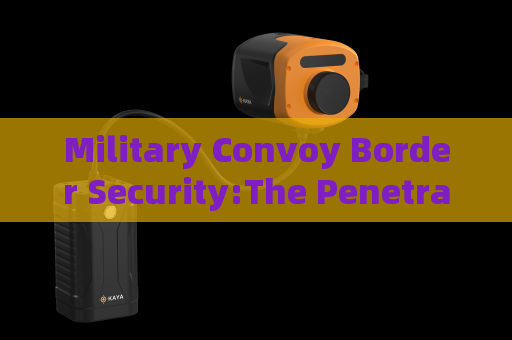
Military Convoy Border Security: The Penetrating Imager delivers remote vehicle surveillance for transport missions A military convoy crossing a border area must treat every approaching vehicle as a potential threat. The interior of a car or truck is hidden by window glazing that creates reflections, tints, and shadows. At night or in adverse weather, the problem worsens. An armed individual can sit completely invisible behind a windshield, awaiting the right moment to act. Traditional observation tools—binoculars, CCTV cameras, or night vision devices—fail to provide a clear view through glass under these conditions. The need for remote vehicle surveillance is urgent, and the Penetrating Imager fills that role by turning the glass into an optically transparent window for the operator. This advanced optical instrument relies entirely on light, using a pulsed laser to actively illuminate the scene in a way that ordinary cameras cannot match. The Penetrating Imager operates on laser range-gated imaging. A high-repetition pulsed laser sends short bursts of light toward the target vehicle. The system's intensified gated camera, built around an MCP image intensifier, a high-voltage module, and a timing module, opens its shutter only for the reflected light arriving from the preselected target distance. This gate rejects the backscatter generated by the glass surface and by particles in the air—fog, mist, rain, or smoke. The resulting image preserves high contrast and resolution even at long range, allowing operators to distinguish occupants and objects behind automotive glass. The ability to perform see-through vehicle glass imaging extends to heavily tinted windows, to reflective windshields, and to situations where strong glare would blind other sensors. Because the imager is an active system, its performance remains stable when ambient light drops to zero. In practice, an operator positions the Penetrating Imager at a protected vantage point, perhaps two hundred meters from a suspected vehicle. The gate interval and gain are fine-tuned to match the exact range and reflectivity of the target. A single scan across the front windshield and side windows provides immediate confirmation of the number of passengers, their hand positions, and any objects held below the window line. The system works in zero-light and low-light environments without revealing the operator's position, since the pulsed laser is not visible to the naked eye. Strong light suppression imaging prevents blinding from oncoming headlights or searchlights, a common countermeasure at checkpoints. Through-glass surveillance of every vehicle in the convoy's security bubble is completed before any soldier leaves the protective perimeter. The resulting imagery appears on a ruggedized military display, giving the commander an immediate real-time view. This capability changes the calculus of border transport missions. A convoy no longer halts to send personnel toward a suspicious van. The Penetrating Imager delivers remote vehicle surveillance from a safe distance, reducing exposure to ambushes and improvised threats. In snow, rain, or haze, the gated imaging still penetrates optical media, providing reliable tactical pictures. The device also handles the specific challenge of through-window tactical observation at night, when adversaries assume darkness grants concealment. The device can be rapidly redeployed between convoy halts, maintaining continuous surveillance along the entire border route. With every checkpoint or roadblock, the Penetrating Imager ensures that military convoys see first and act last, preserving both safety and mission momentum.




