At border crossings, law enforcement officers face a persistent problem: vehicle windows with high-tint films or reflective coatings turn the interior into an opaque chamber. A smuggler or armed suspect can be hidden in plain sight, just meters away. Conventional flashlights and spotlights only amplify glare from the glass surface. Officers must either wave the driver out or approach the window directly, both of which create a precarious exposure. The visual barrier is not merely a convenience issue—it is a tactical vulnerability that slows inspections and increases risk. The Penetrating Imager directly targets this scenario by providing a way to see through the glass from a safe position.
The Penetrating Imager employs laser range-gated imaging, also known as gated or time-gated viewing. A high-frequency pulsed laser illuminates the target area, while an image-intensified gated camera opens only for the time it takes light to return from a predetermined distance. Light scattered by the tinted window or atmospheric particles arrives earlier or later than the signal from the vehicle interior, so the gate rejects it. This active imaging method produces high-contrast images at distance and suppresses backscatter. Through-window tactical observation becomes a routine capability for border security teams. The system can be aimed at a vehicle from a stand-off distance, and the operator sees occupants, seats, and objects behind the glass without being visible in a compromising position. With the Penetrating Imager, the tinted window no longer functions as a concealment layer.
In practical use at a checkpoint, the system is mounted on a stabilized tripod or a vehicle platform. No physical contact with the target vehicle is required. The operator selects a range setting that matches the distance to the car’s interior and watches a high-resolution display. Even when the window is heavily tinted or the cabin is in deep shadow, the gated image reveals the shapes of passengers and large objects. Strong sunlight or oncoming headlights do not wash out the frame because the imager’s gate rejects stray light. During routine stops, a border officer can complete a through-window scan within seconds and decide whether to escalate or wave the vehicle through. The Penetrating Imager reduces the need for the “lean-in” method, keeping officers out of the driver’s striking range.
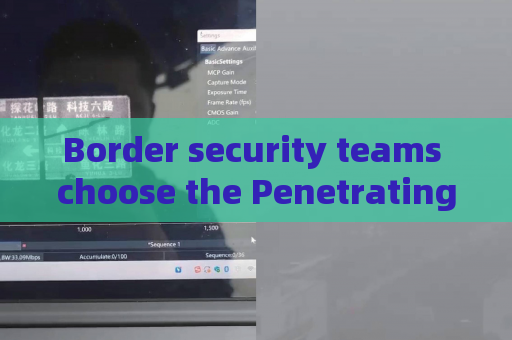
This optical capability remains strictly within the domain of light. It works through glass media such as automotive windows, and it can handle fog, rain, or haze as scattering hurdles—though dense smoke that completely obscures visible light remains a limitation. For the border security context, the key gain is that tinted glass no longer creates a one-way information shield. An officer can observe the rear passenger area, the floor space, or a large parcel on the seat before issuing a single verbal command. That advance in situational awareness changes the pacing of vehicle inspections, making them slower from the threat perspective but faster in reality. The Penetrating Imager turns a known blind spot into a transparent assessment zone while preserving the operational distance that keeps border teams safe.




