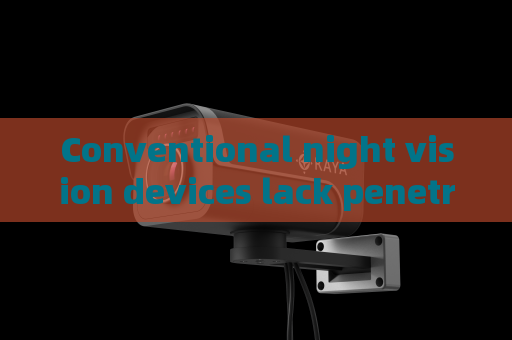
Conventional night vision devices lack penetration capability, and the Penetrating Imager adapts glass and fog environments for effective tactical observation. This capability matters most in vehicle surveillance scenarios. Law enforcement personnel must frequently determine whether a suspect sits inside a parked car, whether a weapon rests on the seat, or whether a driver's hands are visible. Ordinary night vision goggles cannot conduct tactical observation through automotive glass, especially when tinted film or reflective coatings are present. Even in complete darkness, an image intensifier tube picks up only the car's exterior surface; the interior remains a dark void. Fog and rain add another layer of scattering, making the problem even more severe. A patrol team cannot safely walk up to a suspicious vehicle without risking an ambush. The Penetrating Imager solves this stand-off observation problem with laser range-gated imaging. This approach turns a transparent barrier into a manageable optical medium rather than a physical obstacle. The Penetrating Imager consists of a high-repetition-rate pulsed laser, an image-intensified gated camera with an MCP, a high-voltage module, and timing circuitry, plus a beam expander and imaging lens. It illuminates the target with short laser pulses and opens the camera shutter only for a few nanoseconds at the exact time light returns from the chosen distance. Reflections from the glass surface, being closer than the target, arrive earlier and are blocked; backscatter from fog or rain, being at various ranges, is also rejected. This time-gating principle makes the vehicle window virtually transparent to the imager. An operator can aim at the car from a hundred meters away, adjust the range gate to the seat plane, and obtain a clear, high-contrast image of the cabin. Unlike passive night vision, the active laser illumination provides consistent performance in zero-light and low-light conditions. The system's range-gated shutter can be synchronized down to nanoseconds, enabling high-resolution imagery even in fog or rain. In practice, the Penetrating Imager is mounted on a tripod or a vehicle mount and linked to a ruggedized display. After a quick distance measurement, the operator sets the gate delay to match the depth of the target interior. The resulting image shows whether the front seats are occupied, how many passengers are in the rear, and whether any object is held in the hand. This through-glass surveillance can be performed while maintaining a safe distance behind a wall or a police cruiser. Because the system works in the optical spectrum, it is unaffected by glass transparency or light fog; even tinted windows do not defeat the range gate. During a routine traffic stop or a high-risk warrant service, the tactical team can conduct covert recon before making contact, turning an unknown vehicle into a known environment. With suitable magnification, the operator can read a passenger's hand movement or spot a weapon lying on the seat. Conventional night vision devices lack penetration capability; the Penetrating Imager adapts glass and fog environments for effective tactical observation. In the same vehicle inspection scenario, the imager provides more than just visual access. The gated camera suppresses strong light from street lamps and headlights because those sources lie outside the selected range window, preventing overexposure and preserving detail. Smoke from a burning vehicle or fire-related haze is also mitigated to a certain degree, though not thick smoke; but the primary gain is through glass. With a resolution sufficient to distinguish a handgun silhouette or a person leaning forward, the Penetrating Imager gives the tactical commander the needed intelligence before the approach phase ends. Its active design ensures high contrast, long effective range, and immunity to backscatter, making it an indispensable tool for covert through-glass reconnaissance. No other optical instrument offers this level of clarity through vehicle glazing at a safe stand-off distance.




