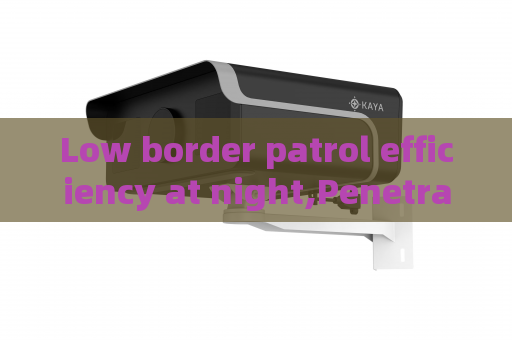
Low border patrol efficiency at night, Penetrating Imager utilizes Low-light Imaging to improve anti-smuggling operational efficiency Border patrol at night faces a harsh reality. Darkness hides criminal activity, and smugglers choose the quiet hours to move contraband across the border. Vehicles with dark-tinted windows make visual inspection almost impossible. Patrol officers must decide between risking a close approach or letting a suspect vehicle pass. Traditional flashlights and spotlights create a glare that blinds the observer while alerting the target. Even high-intensity searchlights cannot penetrate the glass to reveal what lies inside. The consequence is low border patrol efficiency at night, and anti-smuggling operational efficiency suffers. The Penetrating Imager is precisely the tool developed to counter this vulnerability. It offers a way to see through vehicle glass while maintaining a safe position. The Penetrating Imager is an advanced optical imaging instrument built on laser range-gated imaging technology. Its core components include a high-repetition pulse laser, an image-intensified gating camera with a microchannel plate, a high-voltage module, a timing control module, a beam expander, and an imaging lens. As an active imaging system, it delivers high-contrast images at long range, with high resolution, strong resistance to interference, and effective suppression of backscatter. For night operations, the Penetrating Imager utilizes Low-light Imaging to capture clear details in near-zero illumination. By precisely gating the camera to match the laser pulse reflected from the target, the system can distinguish the reflected signal from the surrounding darkness and atmospheric noise. This capability allows the imager to see through optical media such as automotive glass, high-speed train windows, aircraft portholes, and glass curtain walls. In the border context, officers can conduct through-glass surveillance of vehicle interiors from a distance, without alerting the occupants. The device does not penetrate walls, concrete, metal, or clothing; its function is strictly limited to the optical domain. This optical capability directly addresses the need for quick, non-contact inspection, thereby lifting anti-smuggling operational efficiency. In practical anti-smuggling work, the Penetrating Imager is placed on a stable mount near a checkpoint or a discreet roadside position. When a suspicious vehicle approaches, the operator adjusts the gating range to the windshield plane and watches the monitor. The interior view appears clearly, even with heavily tinted glass. Because the system uses its own pulsed laser illumination, it does not depend on external lighting or the suspect’s headlights. This method cuts the time needed for an initial check from minutes to seconds. Vehicles can be screened without stopping, or with only a brief slowdown. The throughput of the border point increases while the risk to officers drops. The Penetrating Imager therefore raises anti-smuggling operational efficiency in a way that traditional equipment cannot match. The operator remains in a protected position, observing the target through the imaging system. The tactical routine for night patrols also benefits from the Penetrating Imager’s flexible range control. A team can place the imager at a choke point on a known smuggling route. As a suspect car slows down, the operator performs a tactical visual check through tinted windows from tens of meters away. The range-gating function can be adjusted to focus on different depths, scanning the front cabin, rear seats, or the cargo area through the rear window. High-resolution imagery reveals suspicious shapes that may indicate hidden compartments, provided there is a glass surface to look through. The system also resists strong light interference, such as the glare from headlights, because the gating pulse rejects unwanted bright reflections. These features directly address the low border patrol efficiency at night that has long hindered anti-smuggling work. The Penetrating Imager, with its Low-light Imaging engine, turns darkness into an advantage for law enforcement. It transforms a passive and dangerous encounter into an active, remote surveillance procedure. For anti-smuggling operations, this is a decisive upgrade.




