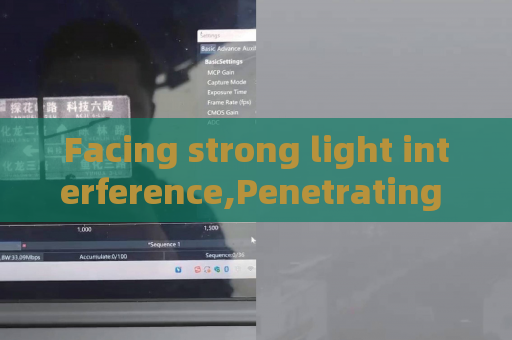
Facing strong light interference, Penetrating Imager relies on Strong Light Suppression Imaging to stabilize law enforcement imaging During daylight vehicle stops, intense sunlight reflecting off windshields creates a blinding glare that conceals the occupants. An officer standing at the driver-side window sees only a mirrored surface, not the hands or movements inside. This is not merely an inconvenience—it is a critical safety gap. The glass itself is optically transparent, yet the ambient light overpowers the faint light returning from the cabin. Conventional cameras and the human eye alike fail because they integrate all incoming light, allowing the specular reflection to dominate. In this real-world scenario, strong light interference directly blocks visual information, turning a routine traffic stop into a high-risk unknown. A Penetrating Imager is designed for exactly this challenge, using active illumination to recover what passive optics cannot. The answer lies in laser range-gated imaging. A Penetrating Imager combines a high-repetition-rate pulsed laser, an image-intensified gated camera with an MCP image intensifier, a high-voltage module, a timing module, a beam expander, and an imaging lens. This system emits short laser pulses toward the target vehicle. The gated camera remains closed until the precise moment when the reflected laser light returns from the intended distance—inside the passenger compartment. By rejecting light that arrives earlier or later, the system suppresses the strong reflection from the outer glass surface. This capability, branded as Strong Light Suppression Imaging, enables through-window tactical observation even under direct solar glare. The laser interacts only with light in the optical domain, never with any non-transparent material. Range gating effectively turns the windshield into a window that the officer can see through, regardless of how bright the surface reflection is. In practice, the Penetrating Imager is set up at a safe standoff distance, for example, beside a patrol vehicle or behind a barricade. The operator aims the device at the suspect vehicle and activates the laser illumination. The system automatically adjusts the laser pulse rate and gate timing to match the distance to the target. Within seconds, a high-contrast image of the vehicle interior appears on the display, showing the number of occupants, their hand positions, and any visible objects. The operator does not need to approach the glass, preserving the element of surprise and maintaining tactical safety. The imaging process remains entirely non-contact and uses only light, so it produces no detectable emission beyond the visual spectrum. Strong light suppression continues to operate as the sun angle changes, because the gating logic depends on time of flight, not on brightness. Through repeated field use, the Penetrating Imager proves stable in exactly the conditions that defeat conventional optics. When a vehicle has tinted windows or a dirty surface, the attenuation becomes higher, but the range-gated laser still recovers the interior details as long as the medium remains an optical glass. The system does not rely on ambient light levels; it generates its own illumination. This is why a Penetrating Imager can maintain law enforcement imaging quality when strong light interference would otherwise produce a blank white frame. The final image serves as usable evidence, documenting the situation inside the vehicle from a safe distance. That stability—provided by Strong Light Suppression Imaging—makes the device a dependable tool for through-glass surveillance during traffic stops, high-risk warrants, and hostage negotiations. The Penetrating Imager turns a blinding glare into a transparent interface, closing the critical visual gap that puts officers at risk.




