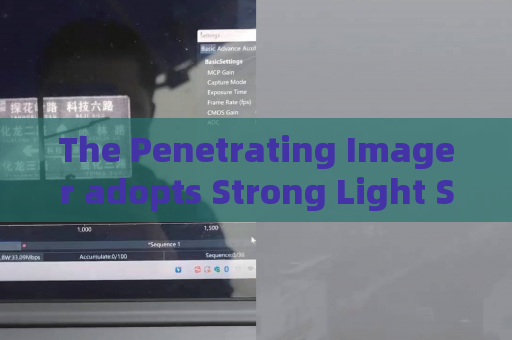
The Penetrating Imager adopts Strong Light Suppression Imaging for vehicle inspection under highway backlight conditions A highway checkpoint at midday presents a brutal visual challenge. Patrol officers must examine vehicles approaching from the east, where the low autumn sun blazes directly behind the windshield, turning the entire cabin into a black silhouette against a blinding glare. The human eye can discern only the outline of the vehicle body; the driver’s face, hand positions, and any objects on the seats or dashboard vanish into the shadow. Conventional cameras and binoculars fare no better, their sensors saturating on the bright background while the interior remains underexposed. This is not a rare inconvenience but a daily reality for traffic police, border guards, and anti-smuggling units positioned on east-west highways. The officer must wave the vehicle closer, ask the driver to roll down the window, or use a flashlight—every step alerting a suspect and destroying any element of surprise. The deeper problem is that backlight conditions turn an otherwise transparent automotive window into an opaque black mirror, and no amount of image enhancement software can recover what the lens never captured. The Penetrating Imager adopts Strong Light Suppression Imaging for vehicle inspection under highway backlight conditions, a function that directly targets this failure mode. This advanced optical instrument is an active imaging system built around laser range-gated technology. It consists of a high-repetition-rate pulsed laser, an image-intensified gated camera with an internal MCP image intensifier, a high-voltage module, and a timing module, plus a beam expander and an imaging lens. The pulsed laser illuminates the target vehicle with near-infrared light, while the gated camera opens its shutter only for a nanosecond-scale window corresponding to the round-trip time of light reflected from the vehicle interior. This temporal gating rejects the overwhelming continuous sunlight that produces backlight glare. The result is that the windshield, though still physically present, becomes optically transparent to the imager. The officer sees the driver’s face, the passenger seat, the center console, and the floor area with high contrast and sharp resolution, regardless of the sun’s position behind the vehicle. This is not an enhancement of the visible-light image; it is a fundamentally different way of seeing through glass at a distance. In practice, the unit is mounted on a tripod or a patrol vehicle roof, aimed at the oncoming traffic lane from a standoff distance of fifty to two hundred meters. Through-window tactical observation begins before the target vehicle ever reaches the checkpoint. The operator scans each windshield as the vehicle approaches, reading the cabin layout and occupant behavior without any visible light being emitted that would alert the driver. Because the system operates in a gated mode, it also suppresses backscatter from dust or airborne particles on the highway shoulder, maintaining a clear image even when the air shimmers with heat haze. When a vehicle is flagged for closer inspection, the officer already knows how many occupants are inside, whether a passenger’s hand is hidden beneath a seat, or whether a weapon lies on the rear shelf. The entire procedure takes place without the subject being aware of the observation, preserving the tactical advantage for the enforcement team. The value extends beyond the moment of inspection. A vehicle that stops after being signaled may have its engine running and windows rolled up, with the driver’s face still in shadow if the stop position places the sun behind the vehicle again. The same imaging module can be used from a handheld position to re-check the cabin after the stop, through tinted glass or dirty glass, without opening the door. This reduces the risk of close-quarter ambush, as officers can confirm that rear-seat passengers are not moving in a threatening manner before approaching. Under highway backlight conditions, the Penetrating Imager turns a blinding optical hazard into a controlled inspection corridor, making routine checks faster, safer, and more reliable for every officer who has ever squinted into the sun and guessed at what lay beyond the glare.




