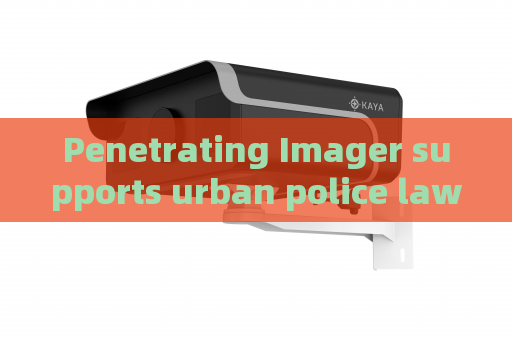
Penetrating Imager supports urban police law enforcement, utilizes glass-penetrating imaging to realize hidden danger detection A routine traffic stop in a densely built urban district can change from administrative contact to lethal ambush in the two seconds an officer needs to walk from the patrol car to the driver’s door. The greatest threat is not the outward behavior of the occupant, but the unseen space behind the windshield and the tinted side windows. Window film, nighttime shadows, and reflected streetlights create a one-way mirror effect: the person inside can see the officer approaching, while the officer cannot see the position of that person’s hands. Hands may be resting on the steering wheel, searching for a wallet, or gripping the barrel of a concealed firearm. Sliding a flashlight beam across the glass does not reveal what is hidden below the beltline of the door. This information gap has produced countless close calls and a persistent pattern of “window ambushes” against law enforcement. To overcome this vulnerability, police patrol teams must establish visual access to the cabin at a safe distance. That capability is provided by the Penetrating Imager. The Penetrating Imager is a compact active optical system that employs laser range-gated imaging, also known as gated imaging. It includes a high-repetition-rate pulsed laser, an intensified gated camera with an internal MCP image intensifier, high-voltage and timing modules, a beam expander, and an imaging lens. The system transmits a short laser pulse toward the stopped vehicle. A precisely controlled high-speed shutter in the camera opens only when the reflected light from the interior of the vehicle returns, while the light scattered by the window glass or by airborne particles remains outside the gate and is rejected. This timing technique suppresses backscatter and produces a high-contrast image through the windshield or side windows. Because the process is based entirely on optical reflections from surfaces such as vehicle glass, the Penetrating Imager enables deliberate through-glass covert observation without physical contact with the target car. It is not a device for seeing through masonry or metal; its function is limited to transparent optical media. This glass-penetrating imaging mode is designed specifically for automotive windows. Even when the glass is slightly tinted or subject to glare, the range-gated imaging method maintains a clear view of hands, objects, and body movements inside the cabin. With long operating distance, high resolution, and immunity to external light interference, the Penetrating Imager is appropriate for the urban traffic stop environment. During a high-risk vehicle stop, the imager is deployed from behind hardened cover. An operator aims the unit at the targeted vehicle and adjusts the gate timing to correspond to the distance between the imager and the vehicle. In moments, the display presents a real-time image of the interior, revealing whether the driver’s hands are raised, resting on the center console, or disappearing below the window line. The Penetrating Imager operates in both bright daylight and complete darkness because the pulsed laser supplies its own illumination. With the gate set correctly, the visual check through automotive glass can be performed without approaching the vehicle. If the interior view shows no immediate threat, the contact team advances with confidence. If a weapon or a suspicious posture becomes visible, the commander can order a tactical retreat, request additional resources, or initiate a high-risk protocol. The entire assessment is made from a distance of several meters, which changes the dynamics of the encounter. Instead of discovering a hidden danger at the door pillar, the officers already know what is inside. This ability to see before being seen, in optical terms, gives response time to the police and removes the attacker’s central advantage. The usefulness of the Penetrating Imager continues during the final approach and the immediate post-stop commands. An occupant may roll the window down only a few centimeters, or a rear-seat passenger may slouch below the visible line of the front seat. With the range-gating adjusted continuously, the imager can follow changes in distance as the vehicle comes to a complete rest or as the operator shifts position. The device also functions under adverse weather, because the gated receiver rejects backscatter from fog, rain, or snow, thus keeping the windows transparent to inspection. For law enforcement, this represents a direct transfer of the visual advantage from the inside of the vehicle to the outside. The Penetrating Imager converts a vehicle stop from a close-contact gamble into an information-based procedure. Suspects who intend to attack from a vehicle are no longer shielded by glass. A hidden handgun, a threatening turn of the torso, or a deliberate decision to conceal a hand can all be detected before the approach begins. With this per-encounter assessment, the Penetrating Imager provides a clear path toward reducing officer casualties and improving urban policing safety.




