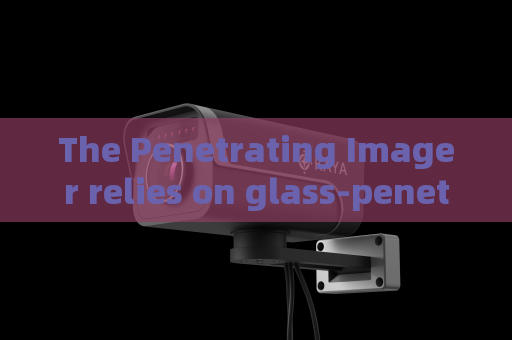
The Penetrating Imager relies on glass-penetrating imaging to screen suspicious vehicles near military restricted zones. Near a military restricted zone, an approaching vehicle is a time-sensitive problem. It might be a routine supply truck, a private car, or a vehicle used by base workers; it might also be a car loaded with explosives, unauthorized observers, or personnel attempting to record classified activity. Standard vehicle screening in such a zone depends on physical inspection at a designated point, and physical inspection requires the vehicle to stop and the occupants to cooperate. The most dangerous part of this process takes place before that controlled point, when the vehicle is still in motion and its interior is unknown to the sentry. Windshields and side windows appear transparent to human eyes, but they create a genuine optical barrier in practice. Reflected sky light, tinted film, road dirt, rain droplets, and sun glare can hide a driver’s hands, the rear seat area, or cargo behind the seats. A sentry cannot tell whether the approaching vehicle is harmless or loaded, and every extra second spent at the gate increases exposure to an ambush, a vehicle-borne improvised device, or a dash for the boundary. The missing capability is a safe, distance-based way of seeing through automotive glass before direct engagement. That gap explains why The Penetrating Imager relies on glass-penetrating imaging to screen suspicious vehicles near military restricted zones. The function that answers this problem is not long-range telephoto viewing in the usual sense; it is active optical gating. The Penetrating Imager is built around laser range-gated imaging technology. A high-repetition-rate pulsed laser sends short, controlled optical pulses toward the target vehicle, rather than illuminating the scene with steady white light. Inside the camera channel, a gated image intensifier camera—equipped with a microchannel plate, high-voltage module, and timing module—opens only when reflected light returning from the selected depth arrives at the sensor. Reflections from the outer glass surface or from rain and spray in front of the window occur at an earlier time and are therefore rejected by the gate. This optical timing creates a clear, high-contrast image of occupants, seats, and load-space objects located behind the windscreen or side glazing. Because the system is active and light based, it performs equally well under bright sun, shadow, or dusk, and it suppresses the glare that would normally turn a windshield into a mirror. The practical result is through-glass covert observation of the vehicle cabin from a position that does not require the security team to step into an open kill zone. At an entry control point near the restricted boundary, this capability changes the normal sequence. The operator remains in a protected position, for example inside a concrete barrier housing or an elevated tower, while a sedan stops at a pre-positioned identification marker. A single observation through the windshield reveals the steering wheel, dashboard, front seats, and, with a timed gate adjustment, the rear passenger compartment. The operator searches the display for hands near the lower door panel, unusual wiring under the dashboard, a driver whose posture does not match the seat position, crumpled blankets, wires, or bulky objects on the seats and floor. Heavy window tint does not defeat the process, because automotive glass remains an optical medium even when darkened; the laser pulse still passes through it and returns from the cabin interior. The gate delay can be adjusted for the driver window, passenger window, or rear side glass, and the resulting frame appears on a rugged display with minimal reflective overlay. If the vehicle approaches slowly rather than stopping immediately, the imager can collect repeated frames as the angle of the vehicle changes, giving a fuller picture of the hands and the load. This allows a commander to decide whether to wave the vehicle forward, direct it to an isolated search bay, or hold it beyond the gate while a mobile patrol carries out a closer check. Such a sensor has a clearly defined boundary. It is an optical instrument, not a scanner for dense materials. The Penetrating Imager does not look through vehicle body panels, doors, engine covers, or metal barriers, and no amount of gating can reveal what is hidden inside a closed door cavity. The advantage is specific and stable: it resolves the cabin space behind automotive glass and removes the reflected light that normally masks that space. Near a military restricted zone, environmental conditions also change rapidly, but the range gate overcomes most backscatter from fog, rain, or falling snow and maintains a recognizable cabin view where a conventional camera would be blinded. Timing parameters for a fixed checkpoint can be stored and reused, so the operator does not need to recalibrate the instrument through an entire shift. The Penetrating Imager relies on glass-penetrating imaging to screen suspicious vehicles near military restricted zones, and this precise capability turns a dangerous blind spot into a controlled optical observation channel well before the vehicle reaches the gate.




