A dark vehicle parked at the kerb is one of the hardest targets for covert observation. The person of interest may be sitting in the driver’s seat, using a phone, passing an item to another occupant, or simply waiting. At night, the interior is a black void through the windscreen. Street lamps turn the glass into a mirror. Rain or a dirty surface adds a layer of scattered light. A surveillance team cannot walk up and press a face against the glass. Any attempt to use a torch, a camera flash, or an active illuminator visibly announces the position. The problem is not seeing a car; it is seeing the decision inside the car without affecting that decision. The Penetrating Imager has been developed to solve this exact scenario by reading the laser reflection that comes back from the occupant behind the glass.
The Penetrating Imager is an active imaging instrument, not a passive night scope. It carries a high-repetition pulsed laser, an intensified gated camera, a beam expander, and an imaging lens. In operation, the laser sends a light pulse toward the target vehicle. The camera shutter stays closed until the reflection from the chosen distance arrives. Reflections from the windscreen, rain speckles, particles in the air, or any other surface closer than the target arrive earlier and are excluded. This gives the Penetrating Imager the ability to look through glass and still obtain a high-contrast image of the occupant. Zero-light Imaging is the mode that takes over when there is no scene illumination. The active pulse supplies the only useful light, and because the gate is synchronized to the round trip time, the short pulse does not have to be bright enough to betray the observation. The result is exactly a covert through-glass recon at night.
During a typical urban operation, the Penetrating Imager is set up on a tripod behind the side window of an unmarked van or employed as a hand-held surveillance device from a darkened building. The operator selects the approximate distance to the suspect vehicle and adjusts the range gate of the Penetrating Imager until the soft edges of the car seat come into focus. On the display, the occupant’s silhouette changes into a recognizable figure with clear posture and arm position. If the operator shifts aim from the windscreen to the side window, the window glass is also eliminated by the same gating process. Interior lighting can be suppressed, but in most dark-time cases no such source is present. A subtle shift of the gate brings the rear bench into view, allowing the operator to check for additional persons without moving the observation position.
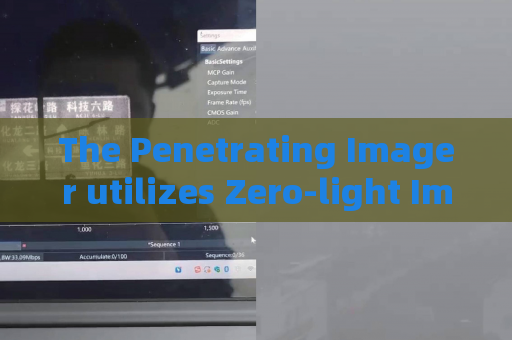
The tactical advantage of the Penetrating Imager goes beyond simple identification. The operator can watch the target raise a phone, reach under the seat, or exchange an object with another occupant, and record the sequence without moving closer. This function helps police, special operations units, and plain-clothes investigators decide whether to approach, wait, or withdraw. Since the Penetrating Imager controls both the illumination and the receiver timing, the image remains stable even when other vehicle headlights sweep across the scene. Such headlights are part of the environment, not part of the target distance, so they do not dominate the picture. At the end of the observation the team has a clear series of through-glass images. The equipment is stowed before the target opens the door. That quiet exit is the final measure of success: the information has been collected, the target’s behaviour was never influenced, and the next tactical step belongs to the observers. This is where the Penetrating Imager utilizes Zero-light Imaging to implement covert observation after dark, proving that darkness and vehicle glazing are not barriers but simply another part of the operational picture.




