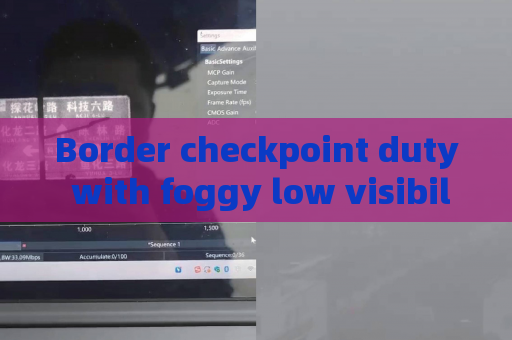
Border checkpoint duty with foggy low visibility, Penetrating Imager adopts Fog Penetration Imaging to maintain continuous monitoring Border checkpoint duty with foggy low visibility does not simply slow traffic; it transforms the first line of control into a decision gap. A vehicle’s lights can be seen long before its body, while its number of passengers, driving posture, and movements inside the cabin stay hidden until the last possible moment. A checkpoint that normally manages contact from a safe distance is suddenly reduced to short-range reaction. Officers must either pull all traffic into a halted queue, step into the obscured lane to make visual contact, or accept that a vehicle will arrive almost unread at the stopping point. In a threat scenario, that is exactly the moment when a checkpoint loses its advantage. The missing piece is a clear field of view through the fog itself, and this is the capability that a Penetrating Imager can place inside the post. The Penetrating Imager is an active optical imaging instrument built around laser range-gated imaging, commonly called gated imaging. A high-repetition pulse laser sends a controlled beam through a beam expander along the approach lane. The receiver, an image-intensified gated camera with a micro-channel plate, high-voltage module, timing module, and an imaging lens, opens its electronic shutter only when reflected light from a selected range is expected. Light scattered back by nearby fog particles arrives earlier than light from the intended vehicle, so that early portion is shut out before it can form a bright veil on the sensor. Rejecting that backscatter recovers image contrast and range. In fixed use at a crossing point, the Penetrating Imager adopts Fog Penetration Imaging to maintain continuous monitoring of vehicles rolling toward the gate. When the range gate is set to the vehicle cabin, the resulting image can be used for through-window tactical observation without requiring the driver to stop first. During practical operation, the gated image appears as a live view in the control post. The operator can shift the gate from a distant segment of the approach road to a closer holding lane as the vehicle advances, so the target remains inside the selected optical slice. Dense fog may still surround the area, but the display shows a cleaner vehicle silhouette, a defined roofline, and the movement of occupants behind the glass. Braking behavior can be assessed while the vehicle is still outside the barrier zone; erratic changes of speed or direction become visible earlier. Because the system relies on precisely timed light rather than broad ambient illumination, a target is not lost in the normal white wall of headlight glare and scattering that ordinary optical systems suffer from in mist. This allows the checkpoint to keep evaluating the same object from its first appearance at range until it enters the inspection area. The Penetrating Imager is therefore not limited to short, single-frame glances. The same gated configuration can remain active for long periods, tracking the queue as it moves slowly through the fog. At a border post, where weather may last for hours and vehicles must keep moving, this is what turns a moment of visibility into a dependable operational picture. Border checkpoint duty with foggy low visibility no longer means relying on a surprise face at the window. The fixed post can hold the cabin view, maintain a record of each approach, and support decisions in real time because the image is sharp enough to use. Optical fog remains present, but the image layer that matters has already been separated from it.




