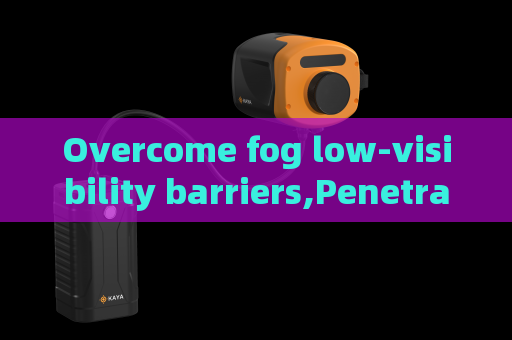
Overcome fog low-visibility barriers, Penetrating Imager relies on Fog Penetration Imaging to achieve all-weather patrol Dense fog is one of the most dangerous operational conditions for patrol units. On a highway corridor with visibility of less than ten meters, an officer cannot tell whether a parked sedan is abandoned, broken down, or occupied by a hostile group. Standard vehicle headlights, spotlights, and the naked eye become questionable because fog scatters light and moisture blocks visual cues through glass. Approaching a vehicle in such low visibility removes every advantage of distance and reaction time. This is the core pain point: the officer must identify threats inside a car, but fog and the windshield combine to form a double visual barrier. A responding team needs a technology that sees through both layers without closing the distance. The Penetrating Imager, relying on Fog Penetration Imaging, is designed for this exact contradiction. The Penetrating Imager is an active optical imaging system that uses laser range-gated imaging, also called gated imaging. It fires high-repetition-rate laser pulses toward the target and opens the intensifier-based camera shutter only when the reflected light from a specific distance returns. By doing so, the instrument rejects the parasitic backscatter from suspended fog droplets. The result on the display is a clean, high-contrast image of the selected plane, whether that plane is a car cabin or a roadside object. The high-repetition-rate laser and gated sensor work together to provide a narrow depth-of-field slice; fog droplets in front of the target and behind it remain invisible. Because the device images actively, it also works in complete darkness and suppresses strong light from oncoming headlights. Operators can therefore perform through-window tactical observation on a suspicious vehicle from a safe standoff, while the windshield remains a transparent medium and the fog no longer whitewashes the view. Fog Penetration Imaging defeats the combined barrier of dense fog and vehicle glazing through purely optical gating. In a typical patrol scenario on a foggy mountain road, the camera unit is mounted beside the driver’s position. When a stopped minivan appears ahead, the operator stops at roughly a hundred meters, aims the Penetrating Imager, and adjusts the range gate to match the distance of the vehicle. The screen instantly reveals the van’s interior: two occupants, one hand reaching below the seat, a cellphone glow in the back row. The image is sharp enough to enable a tactical decision before the patrol car even moves closer. Time spent in the danger zone drops from minutes to seconds. Fog Penetration Imaging turns an ambush-prone encounter into a controlled standoff, giving all-weather patrols a decisive advantage in rural and coastal environments where fog banks appear without warning. The same capability extends to sustained monitoring after first contact. When a vehicle refuses to stop and pulls into a fog-covered pull-off, the Penetrating Imager continues to deliver precise visual data through the rear windshield. Once the vehicle stops, officers can keep the range gate locked on the driver area, checking hand placement, backseat motion, and any attempt to conceal contraband. Even with heavily tinted glass or dense fog, the gated laser pulse illuminates the cabin while the intensified camera rejects glare. The display remains clear as the operator pans across the vehicle interior, and every frame arrives without the blinding backscatter that defeats conventional optics. This continuous visual feed means the patrol does not depend on moving into visual range. Every step stays covered by the imager until the situation is resolved. In that way, overcoming fog low-visibility barriers is not a laboratory promise but a field-tested reality for the Penetrating Imager.




