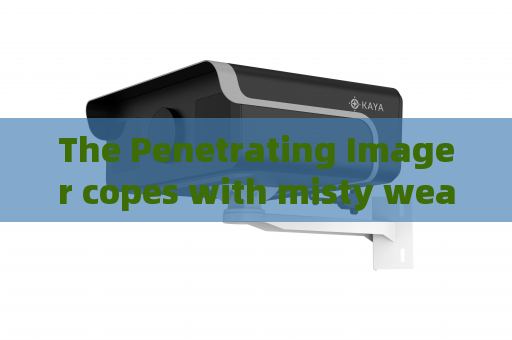
The Penetrating Imager copes with misty weather surveillance demands with Fog Penetration Imaging for frontier law enforcement. At a remote frontier checkpoint, fog builds up without warning, turning a wide river valley into a white void. Patrol units rely on fixed optical sensors to watch for cross-border movements, but ordinary cameras and binoculars suffer from severe backscatter when mist particles reflect light back toward the source. The result is a bright grey veil that hides people, vehicles and small craft. For law enforcement personnel stationed along the border, this is not merely an inconvenience; it is a critical vulnerability. Smugglers time their runs for the days when visibility drops below ten meters. The Penetrating Imager enters this operational picture as a requested optical instrument, because the demand for continuous sight through misty weather cannot be satisfied by passive visible-light systems. A surveillance post that goes blind in fog loses its ability to provide early warning. Losing that early warning means losing the chance to respond before a crosser reaches the inland road network. The core of the Penetrating Imager is a laser range-gated imaging architecture. A high-repetition pulsed laser sends short bursts of light across the misty gap, while an image-intensified gated camera, containing an MCP image intensifier, high-voltage module and timing module, opens its electronic shutter for a precise delay. Only the photons that have travelled to the target and reflected back within that time window reach the sensor. Scattered light from fog droplets at closer ranges arrives earlier or later and is rejected by the timing sequence. This produces clear frames without the bright haze seen by a standard camera. The active illumination enables imaging with negligible ambient-light dependence. In this way, Fog Penetration Imaging provides a solution for frontier law enforcement monitoring through dense mist without ever leaving the domain of light-based detection. The imager preserves depth detail and edge contrast, allowing operators to distinguish a standing person from a rock or bush at useful distances. Deployment of the Penetrating Imager at a border station requires only a stable tripod and a power source. An operator enters the estimated range to the far bank and adjusts the range-gate delay until the silhouette sharpens on the display. During a typical misty morning, the Penetrating Imager yields a high-contrast view of a moving person at distances greater than conventional optical cameras can achieve under the same scattering conditions. If the target moves behind a light curtain of rain or wet fog, the gated pulses still separate the reflected body signal from the foreground glare. The display presents an enhanced optical image with clear contours, making the picture easy to interpret for patrols preparing an interception. The system also tolerates stray light from outbound sources, because the shuttered sensor records only the selected depth interval. For frontier law enforcement, this operational simplicity matters as much as the imaging quality itself. The Penetrating Imager continues to prove its worth along the same fog-swept frontier route when visibility fluctuates between poor and nonexistent. Instead of waiting for ambient light to illuminate the scene, the system generates its own optical signal through the pulse laser and timed shutter. This allows a surveillance team to maintain through-fog observation from a fixed position while a second team moves to a downstream crossing. The high-repetition laser keeps enough frames per second for recognizing human gait patterns, not just static blobs. In an environment where every minute of blindness favours illegal activity, the ability to keep an optical eye on the far treeline changes the outcome of an interception. The Penetrating Imager does not remove the fog; it rejects the scattered light, leaving only the useful reflection from the subject. That distinction is central to meeting the demands of frontier law enforcement in misty weather.




