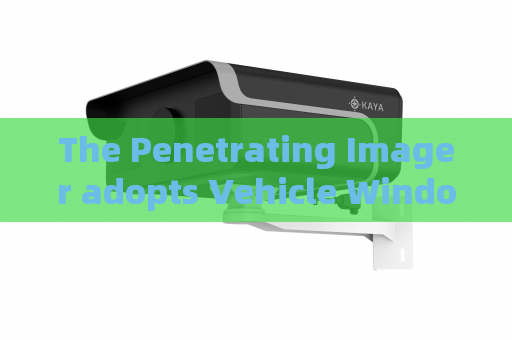
The Penetrating Imager adopts Vehicle Window Penetration to enhance safety during long-distance border patrol operations A border patrol unit routinely encounters vehicles stopped at remote checkpoints or idling along unpaved trails. The immediate challenge lies in assessing occupant behavior without approaching too closely. Sunlight glare, factory-tinted glass, dust, and rain obscure the interior, while a driver’s posture or hand placement near a seat cushion remains invisible to the naked eye. Officers must decide within seconds whether to advance or take cover. Any misjudgment can escalate into an ambush. The lack of a non-contact visual method forces patrols to balance tactical caution against operational urgency. In these vast, isolated stretches, every uncertain approach carries lethal consequences. What is needed is a way to see through automotive glass from a safe standoff distance and obtain a trustworthy image of the vehicle’s interior—without relying on sound, heat, or any non-optical signal. Through-window tactical recce becomes possible with the Penetrating Imager. This advanced optical instrument employs laser range-gated imaging, a gated imaging technique that synchronizes a high-repetition pulsed laser with an intensified gated camera. When aimed at a suspicious vehicle, the system emits short laser pulses and opens the camera shutter only when the reflected light from the target returns. This timing suppresses backscatter from rain, fog, or droplets suspended near the patrol unit. Because the system operates purely in the optical domain, it can transmit through automotive glass—including windshields and side windows—while rejecting reflections from the glass surface. The penetrating imager does not inspect beyond solid barriers. Its function is specific: to strip away optical interference, such as tinted film or bright sky glare, and produce a clear, high-contrast image of occupants behind a transparent medium. For border patrol officers, the device effectively turns a closed vehicle into an open visual space, allowing observation while the patrol vehicle remains hidden at a distance. During a routine border sweep, the patrol stops at a vantage point two hundred meters from a stationary sedan parked near the wire fence. With the Penetrating Imager mounted on a stabilized tripod inside the patrol vehicle, the operator sights through the sedan’s rear window. The system’s laser illuminates the target, and the gated camera resolves the driver’s silhouette, shoulder motion, and both hands resting visibly on the steering wheel. A second occupant leans forward, and the image shows his arm moving toward the floorboard. Because the imager works actively with laser light, it remains unaffected by dusk shadows or headlight beams. Officers can watch the occupants for several minutes without ever exposing themselves. The device displays the scene on a rugged monitor, allowing real-time assessment of body language. If a hand emerges holding a weapon, the patrol can withdraw and call for backup. If the occupants appear calm and unarmed, an approach can be planned with greater confidence. The safety margin extends beyond initial detection. In long-distance patrol operations, the imager can be used repeatedly from behind hills or vegetation, with only the optical head slightly raised above cover. Each observation cycle consumes minimal time, enabling rapid scans of multiple vehicles in a convoy. The laser range-gating process also suppresses the blinding effect of oncoming high beams, preserving image detail where conventional optics fail. The Penetrating Imager does not replace legal judgment or communication procedures, but it provides verified visual intelligence before the first spoken command. Whether facing tinted windows in daylight or a dark interior under moonlight, the patrol has an optical tool that turns uncertainty into a recorded image. That image—obtained through glass without physical approach—directly reduces the risk to officers and strengthens the overall security posture during extended border missions.




