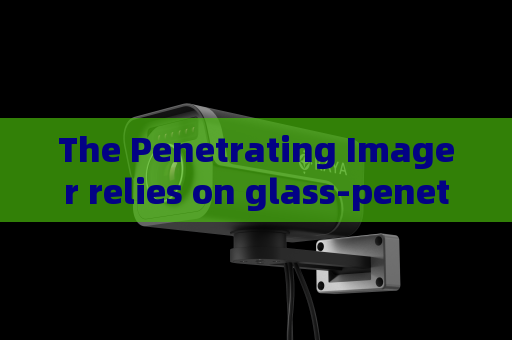
The Penetrating Imager relies on glass-penetrating imaging to fulfill concealed observation requirements of special military missions A dark sedan turns into the holding lane of a checkpoint near a critical installation. Through the windscreen, a perimeter observer sees only the crown of a cap and a static shoulder line. The afternoon sun strikes the pane at a low angle, turning the curved glass into a mirror that hides the entire cabin. The occupant could be reaching for identification or for a weapon. At this distance, no passive optic can separate the reflected sky from the shadowed human figure behind it. The same transparent medium that admits light to the face also bounces glare back into the lens of any observer. Windshield film, dashboard reflections, and a thin layer of road grime add further distortion. This is the quiet failure of conventional surveillance at vehicle approach points: concealed observation is defeated by an ordinary pane. That failure is the precise gap that the Penetrating Imager is designed to close. The Penetrating Imager solves this with an unusual optical method. Instead of letting the glass overwhelm the sensor, the instrument generates its own pulsed laser light and synchronizes the shutter of an image-intensified gated camera to a very narrow moment in time. The timing gate is set for the distance of the person seated inside the car. Reflections returning from the glass surface, from rain film, or from haze arrive at a different moment and are left outside the gate. The result is that the windshield effectively disappears from the image, while the target compartment remains sharp. Because the system relies on straight-line reflected photons, there is no involvement of sound, radio frequencies, or any non-optical mechanism. The military operator is therefore given a high-contrast picture of what is happening behind the glass, even when the glass is heavily tinted or covered with droplets. This provides genuine through-window tactical recce during a developing threat, because the observation can be made from a hidden stationary position without alerting the vehicle’s occupants. In practice, the workflow is short and deliberate. The observer aims the Penetrating Imager at the side window or windscreen from behind a barrier, a low wall, or a concealed post, and adjusts a small range-delay control until the bright smear from the pane disappears. A clean plane of the interior then appears on the monitor. During one vehicle-interception drill, a two-man team used this method to observe a stationary car at the entrance to a fuel depot. They confirmed that the driver’s right hand remained on the wheel, that a passenger was leaning forward with both hands visible, and that the rear seat held no concealed person. That entire assessment was completed before the car moved the last twenty metres to the stop point. The same depth gate could be shifted to the rear side window for a final sweep, then switched back to the front screen without any need to reposition the stand. All optical returns stayed inside the aperture of the instrument, so the subjects received no visible cue that they were being studied. That capability carries into complete darkness at the same checkpoint. After midnight, with the surrounding road lamps extinguished, the Penetrating Imager continues to illuminate the vehicle interior with its own pulsed source. The operator observes in near-zero ambient light, reading the silhouette of a raised arm or a tilted head with the same clarity as in daylight. This active approach also suppresses strong light from the vehicle’s own headlamps because the bright oncoming source falls outside the selected range gate. Thus, for security teams guarding a gate, an entry lane, or a vulnerable convoy stop, the old problem of being blinded by a driver waiting behind glass is replaced by a dependable optical view of his true actions. The Penetrating Imager, through glass-penetrating imaging, fulfills the concealed observation requirement of special military missions without ever compromising the safety of the observer.




