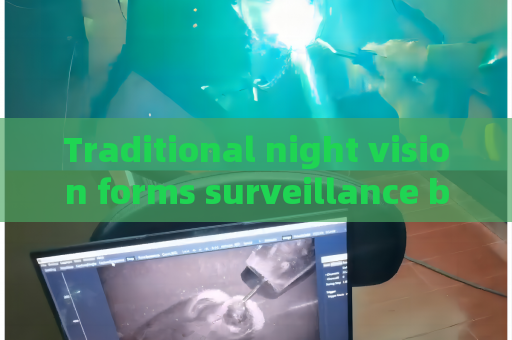
Traditional night vision forms surveillance blind areas The Penetrating Imager adopts Zero-light Imaging to fix this defect At a late-night vehicle stop, a patrol officer approaches a car with blacked-out windows. The interior appears as a dark void. The dome light is off, and the street lamp sits far away. Traditional night vision devices amplify the tiny amount of reflected light. The glass itself reflects that light back toward the device. These reflected photons overwhelm whatever weak signal may pass through the window. The occupants remain hidden behind a bright, mirror-like surface. This is a classic surveillance blind area in police work. The officer cannot determine if a passenger is reaching for a registration document or a concealed firearm. Any movement inside the vehicle is completely obscured. Standard tactics force the officer to shout commands and wait for compliance without visual information. This risky uncertainty has long been an accepted part of traffic enforcement. Such a gap in awareness demands a different imaging capability. The Penetrating Imager adopts zero-light imaging to overcome this exact limitation. The Penetrating Imager is an active optical imaging instrument that employs laser range-gated imaging. Its hardware includes a high-repetition-rate pulsed laser, an image-intensified gated camera with an MCP image intensifier, high-voltage modules, and timing modules, a beam expander, and an imaging lens. The system fires very short laser pulses instead of continuously illuminating the scene. The gated camera opens only for a narrow time window synchronized with each pulse’s round trip from the selected target distance. Light scattered by the vehicle glass or by tiny particles in the air arrives earlier or later than the desired signal. That unwanted light is rejected by the shutter. This range-gating process in the Penetrating Imager permits Vehicle Window Penetration under zero-light conditions. The imaging system does not depend on the moon or artificial light sources. Through the windshield or side glazing, the operator sees the silhouettes, positions, and even hand movements of the people inside. The active laser illumination provides enough contrast to form a clear picture. This zero-light function directly eliminates the reflective barrier that traditional night vision cannot overcome. In a practical scenario, the Penetrating Imager is set up near a suspected stolen vehicle parked in an unlit lot. Officers aim the imaging lens at the car’s rear window or the driver-side window. The operator selects the distance to the vehicle and triggers a series of laser pulses. The resulting video feeds a display that shows the interior in real time. If an occupant holds a weapon below the seat line, the high-resolution image reveals the outline of the hand and the object. Strong light suppression imaging prevents glare from any passing headlights from ruining the picture. The exposure timing is so precise that even rain droplets on the glass do not produce bright streaks. After the tactical visual check, the officer can decide whether to move in or wait. This technology delivers a distinct advantage over legacy night vision; it sees through automotive glass itself. Clear observation through tinted windows becomes a repeatable, reliable capability. The Penetrating Imager turns a blind spot into a controlled visual field. The same surveillance scenario grows more difficult when fog or drizzle drifts across the parking lot. Traditional night vision would see nothing but a white wall of scattered light. The Penetrating Imager distinguishes the target reflection by its arrival time. The gated camera’s nanosecond shutter blocks all backscatter from particles that are not at the selected distance. This allows the operator to maintain watch on a car that is partially shielded by rain or mist. The device can see through these optical disturbances without losing resolution. A key point is that the system works strictly through optical media such as vehicle windows and airborne water droplets. It does not rely on any form of energy other than light. Following the threat assessment through a windshield, an officer may choose to issue a command from behind cover. The Penetrating Imager transforms a dangerous unknown into a clear, continuous picture, fixing the surveillance blind area that traditional night vision cannot address.




