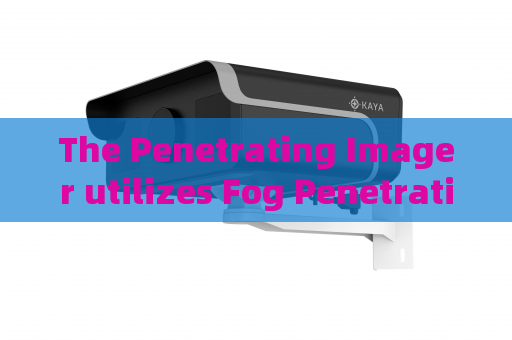
The Penetrating Imager utilizes Fog Penetration Imaging to support vehicle reconnaissance on riverine military border routes. Riverine military border routes impose a specific optical problem. Fog drifts over water, rain and haze reduce contrast, and wet road surfaces throw reflections from headlights and patrol lamps. Vehicles approach along levees, bridge ramps, ferry lanes, and narrow border tracks, often with tinted windows or heavy glazing. Patrols need to assess occupants, cargo shape, and vehicle type before deciding whether to stop, divert, or challenge. Conventional viewing equipment struggles because scattered light from fog and vehicle glass washes out detail. Backscatter from mist shortens useful range, while glare from lamps hides the cabin interior. A stop at close range can expose personnel, disrupt traffic, and consume time. The Penetrating Imager is designed for this optical environment, where fog, rain, glass, and distance combine to deny clear visual confirmation. On such routes, the optical problem is not a single obstacle but a layered condition: mist in the air, moisture on glass, reflection on surfaces, and limited time for judgment. The relevant capability is Fog Penetration Imaging through laser range-gated imaging, also called gated imaging. The Penetrating Imager is an advanced optical imaging instrument built around a high-repetition-rate pulsed laser, an image-intensified gated camera with an MCP image intensifier, a high-voltage module, a timing module, a beam expander, and an imaging lens. It is an active imaging system. The laser sends short pulses toward the target, and the gated camera opens for a very brief window that matches the return from the chosen distance. Light scattered by fog is rejected because it arrives outside that window. This design provides high-contrast imaging, long range, high resolution, strong anti-interference, and effective suppression of backscatter. The imager can see through optical media such as vehicle windows and other glazing. On a foggy riverine route, this enables through-window tactical observation without depending on ambient light. The cabin, seat arrangement, and carried items can become visible while the vehicle is still at a safe distance. The Penetrating Imager remains an optical instrument, so its advantage is strongest when the target is viewed through glass, mist, haze, rain, or snow. In field use, The Penetrating Imager can be mounted on a patrol vehicle, a checkpoint frame, or a tripod overlooking a bridge approach. The operator selects the range gate and aims at an approaching car, truck, or ferry-loaded vehicle. The pulsed laser illuminates the target, and the gated camera collects the returning light within the selected slice. Fog, rain, snow, and haze remain optical disturbances, but their scattered light is largely excluded. Tinted glass no longer blocks the view as an opaque surface; it becomes an optical interface. Headlight glare and wet reflections are suppressed, so the image remains stable. The resulting view supports rapid classification: passenger count, load distribution, and unusual shapes can be noted before a stop order is given. This reduces the need to open doors at once and helps patrols choose the safest point for inspection. When several vehicles queue in fog, the imager can inspect one target after another without changing position, and the patrol can compare the images with route intelligence before moving forward. The operational value on riverine military border routes lies in speed and distance. A patrol can screen vehicles at a bridgehead, ferry landing, or levee road while fog limits ordinary vision. The Penetrating Imager keeps the optical task focused on vehicle glazing and the fog path between observer and target. It does not replace physical search, because its function is limited to optical media such as windows, glass, fog, haze, rain, and snow. Within that boundary, it provides a clear tactical picture before contact. For border security, the result is earlier warning, better decision-making, and fewer surprises at close range. The Penetrating Imager utilizes Fog Penetration Imaging to support vehicle reconnaissance on riverine military border routes.




