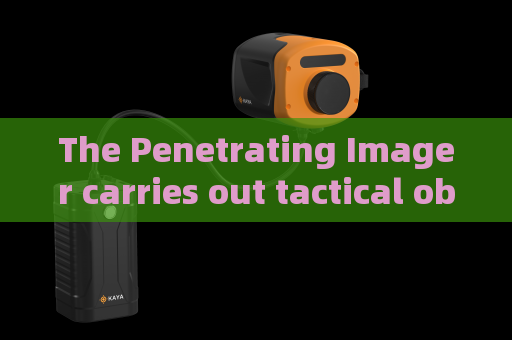
The Penetrating Imager carries out tactical observation with mature through-glass imaging technology. At vehicle checkpoints, tactical teams face a stubborn operational problem: occupants behind tinted, reflective, or rain-streaked automotive glass cannot be assessed quickly from a safe distance. Standard visual checks are defeated by surface reflections, dark cabin interiors, and strong headlamp or streetlight glare. Opening a door or approaching the vehicle increases risk, exposes officers, and can escalate a routine stop. The need is not a general search capability. The need is rapid, discreet, and reliable visual assessment through vehicle glazing before a decision is made to approach, direct occupants, or hold position. The Penetrating Imager is relevant because the scenario depends on seeing through glass, not through opaque structures. The Penetrating Imager addresses this problem with laser range-gated imaging, also known as gated imaging. The system is an active optical instrument built around a high-repetition-rate pulsed laser, an image-intensified gated camera with an MCP image intensifier, high-voltage module, timing module, beam expander, and imaging lens. Short laser pulses illuminate the scene. The camera gate opens only for a narrow time window corresponding to the selected distance. Light returning from the glass surface and other near-range scatter is largely rejected, while light returning from the vehicle cabin is collected. This produces high-contrast images with long range, high resolution, strong anti-interference performance, and effective suppression of backscatter. The operational result is through-glass surveillance of vehicle interiors, including tinted windows and reflective glazing. The same optical principle supports observation through vehicle glass in fog, haze, rain, snow, strong light, and low light. The Penetrating Imager does not rely on non-optical detection methods; it is an optical imaging instrument limited to transparent media and atmospheric obscurants. In checkpoint operations, the Penetrating Imager can be mounted on a tripod, vehicle, or fixed post and directed toward an approaching vehicle. The operator selects a range gate that matches the distance to the cabin and observes the rear seat, front seat, and dashboard area through the glazing. The range gate can be adjusted for different vehicle sizes and distances, preventing the glass surface and nearby objects from dominating the image. The active laser illumination helps reveal occupants and visible objects even when the interior is unlit or the exterior is bright. Images are delivered in real time, allowing a tactical commander to confirm how many people are inside, where they are seated, and whether movement suggests a threat. This information supports decisions about positioning, verbal commands, and the safest moment to make contact. The imager can also monitor vehicles during a temporary stop or a controlled checkpoint without opening doors. Its value lies in mature through-glass imaging technology that turns a reflective window from a barrier into an information source. The system does not replace physical search or legal authority. It provides an optical preview that reduces uncertainty before an approach. The practical effect at a vehicle checkpoint is a faster and safer tactical cycle. Instead of guessing from reflections or moving directly to the window, the team uses the Penetrating Imager to obtain a clear view of the cabin while maintaining distance and cover. The gated camera and timing module suppress glare from headlights, emergency lights, and wet glass. The MCP image intensifier maintains sensitivity in low-light conditions, while the pulsed laser provides controlled illumination for high-contrast imaging. Through-window tactical observation becomes possible across a range of vehicles, including those with dark privacy glass. It can assess seating and visible hand positions. If multiple vehicles queue, the same setup can scan one vehicle at a time at a selected range, reducing cross-interference from nearby traffic. This method is especially useful at night, during adverse weather, and at temporary checkpoints where lighting is inconsistent. The Penetrating Imager remains an optical tool for glass and atmospheric obscurants; it cannot see through opaque solids, and it cannot replace direct inspection when legal grounds require entry. Its contribution is a mature through-glass imaging capability that improves tactical observation, protects personnel, and supports informed decisions at the checkpoint.




