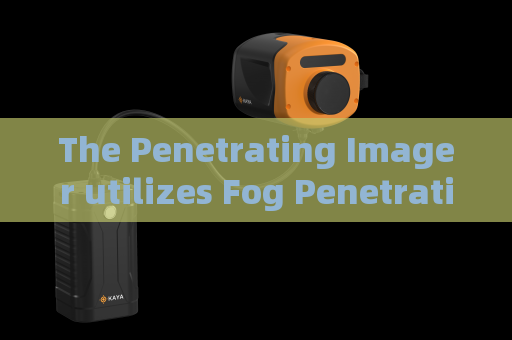
The Penetrating Imager utilizes Fog Penetration Imaging to support vehicle reconnaissance on riverine military border routes. Riverine military border routes combine water, weather, and vehicle traffic into a narrow surveillance problem. Fog, mist, rain, spray, and haze collect over channels and drift across levees, hiding vehicle silhouettes, convoy spacing, plate details, and cabin occupants. Patrol units need timely confirmation of movement at crossing points, ferry landings, bridge approaches, and riverside checkpoints. Ordinary visual observation loses contrast at distance. Tinted glass and wet windows further reduce detail during inspection. The mission is not a broad terrain search. It is a reliable optical read of vehicles under atmospheric scattering. The Penetrating Imager answers this need. It uses Fog Penetration Imaging to support vehicle reconnaissance on riverine military border routes by restoring contrast where fog and water spray obscure the target. The relevant function is laser range-gated imaging, also called gated imaging. The Penetrating Imager is an active optical instrument. A high-repetition-rate pulsed laser illuminates the scene. An image-intensified gated camera, with an MCP image intensifier, high-voltage module, and timing module, opens for a very short interval. A beam expander shapes the laser output, and an imaging lens collects the return. The timing module synchronizes the laser pulse and camera gate, so light returning from the target is accepted while most light scattered by fog, haze, rain, or snow is rejected. This Fog Penetration Imaging delivers high-contrast images with long range, high resolution, strong anti-interference, and effective backscatter suppression. The system remains strictly optical. It can penetrate optical media such as vehicle windows, train windows, aircraft portholes, and glass curtain walls. It also works through fire, fog, haze, rain, and snow. In fire scenes, visibility can improve three to five times. Dense smoke remains a limit. Solid walls, concrete, brick, clothing, metal, and wood are outside its function. On a riverine border route, employment is direct and tactical. A patrol vehicle or checkpoint crew positions the imager on a stable mount overlooking a channel, bridge approach, or ferry landing. In fog or rain, the operator selects gated imaging and sets the range gate to the distance of the target vehicle. The pulsed laser illuminates the vehicle. The gated camera captures the returning light. Water spray, fog droplets, and rain streaks return light earlier and are largely excluded from the selected gate. Vehicle outlines, roof profiles, cargo shapes, and window surfaces appear with greater contrast. When a suspect vehicle approaches, the crew can inspect the cabin area through automotive glass, checking seat occupancy and visible items without physical contact. Standoff is maintained during poor weather. The result supports decisions on stopping, diverting, or escalating inspection while reducing unnecessary exposure for the patrol. This procedure is repeated as traffic appears, giving a continuous optical watch rather than a single snapshot. The operational effect on riverine border routes is measured in time and clarity. Fog often shortens the useful detection window at dawn and dusk. The Penetrating Imager extends that window by restoring optical contrast through scattering layers. A crew can monitor vehicle movement along a levee road, determine whether a vehicle is loaded or empty, and observe cabin details through glass before it reaches a checkpoint. The image remains optical. It does not replace physical inspection or manual search. Its value is early, visual, non-contact awareness under fog, rain, spray, and glare. Repeated use supports pattern recognition: normal traffic flow, unusual stopping, night movement, and convoy behavior. The Penetrating Imager gives border patrols a clearer optical picture when weather and water combine to hide the facts they need. The tactical picture remains limited to what light can reveal through transparent or semi-transparent media, and the crew must still treat every vehicle as a potential threat until a physical check is complete.




