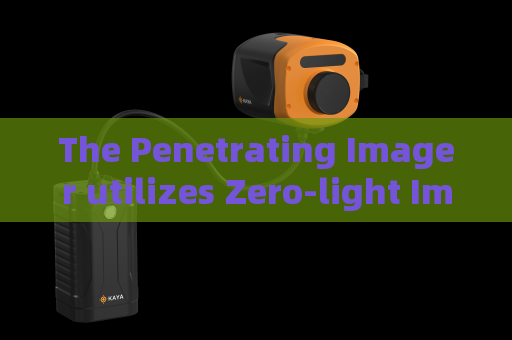
The Penetrating Imager utilizes Zero-light Imaging to complete concealed target observation for field military units. Field military units conducting night operations face a persistent tactical problem. Concealed targets positioned behind vehicle windows, glass curtain walls, or similar transparent barriers remain invisible to standard optical devices. Ambient light is absent or extremely low. Ordinary low-light cameras cannot form an image without photons, and passive optical systems fail when glass reflects the surrounding darkness. Tinted windows further reduce light transmission, turning a vehicle interior into a black box. An enemy can therefore hide personnel, weapons, or sensitive equipment behind automotive glazing or building glass, knowing that the barrier blocks direct observation. Active illumination with visible light would expose the unit's position and create severe glare from the glass surface. The challenge is compounded by the need for covertness; any active source that reveals the unit's location is unacceptable. The result is a dangerous blind spot where concealed targets can move, observe, or prepare attacks without being seen. The Penetrating Imager with Zero-light Imaging is designed to close this gap. The Penetrating Imager is an advanced optical instrument that uses laser range-gated imaging, also known as gated imaging. Its components include a high-repetition-rate pulsed laser, an image-intensified gated camera with an internal MCP image intensifier, high-voltage module, and timing module, a beam expander, and an imaging lens. As an active imaging system, the device delivers high-contrast images, long range, high resolution, strong anti-interference capability, and effective suppression of backscatter. The timing module synchronizes the laser pulse with the camera gate, so the camera only receives light returning from a selected distance. The MCP image intensifier amplifies the weak return signal. The narrow spectral band of the laser reduces the chance of detection by enemy optical sensors. The system operates on Zero-light Imaging, meaning no ambient light is required for clear observation. It penetrates optical media such as vehicle windows, high-speed train windows, aircraft portholes, and glass curtain walls. This enables covert through-glass recon of targets hidden behind transparent barriers. The technology is limited to optical media and does not penetrate opaque solids such as walls, concrete, or metal. In field use, a military unit deploys the Penetrating Imager on a tripod, vehicle mount, or handheld platform. The operator aims the device at a suspected vehicle or building glass facade. The pulsed laser illuminates the scene, and the gated camera opens its shutter for a very short time window matched to the target distance behind the glass. Light reflected from the concealed target passes through the glass and reaches the camera, while glass surface reflections and atmospheric backscatter are excluded. The resulting image reveals personnel, weapons, or equipment inside the vehicle or behind the window. Zero-light Imaging ensures clear observation in total darkness. The operator can adjust the range gate to focus on different depths, checking the front seat, rear seat, or cargo area of a vehicle. The image can be displayed on a rugged monitor for immediate tactical assessment. The system also maintains performance through fog, haze, rain, and snow. In fire scenes, visibility improves by three to five times, though dense smoke remains a limitation. The Penetrating Imager can be integrated into handheld or drone-mounted configurations for tactical recce. Its long range and high resolution allow identification of concealed targets from a safe standoff distance. The active laser operates at a high repetition rate, delivering real-time video with minimal latency. Because the gating rejects backscatter, the image remains sharp even when glass creates reflections. Battery operation and rugged housing support extended field use. Field units can conduct covert observation through vehicle glazing or glass curtain walls without switching on visible lights or any source that might alert the enemy. The Penetrating Imager thus completes concealed target observation for field military units, turning dark glass into a transparent tactical window. Zero-light Imaging remains the core enabler for this mission.




