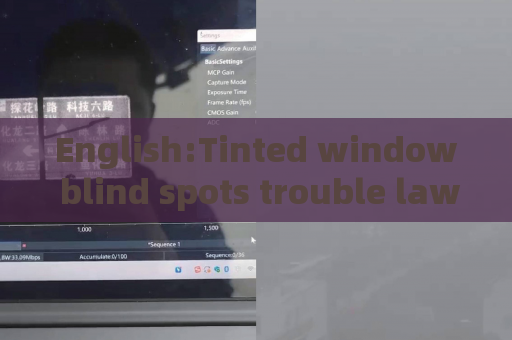
English: Tinted window blind spots trouble law enforcement The Penetrating Imager utilizes Vehicle Window Penetration At night, a patrol unit stops a vehicle with deeply tinted glass. The officer approaches a cabin that functions as a dark box. Legal tint limits exist, yet layered films, privacy glass, rain, and strong streetlight reflections can reduce visibility far below what a quick visual check requires. The driver and passengers may be seated normally, but hands, waistbands, floorboards, and rear seats remain uncertain. A simple tint meter may confirm a violation, but it does not reveal who is inside or what is within reach. A tinted window creates a blind spot at the exact moment when threat assessment matters most. Flashlights often wash out the outer surface and bounce back into the officer’s eyes, while the interior stays low contrast. The Penetrating Imager is designed for this specific law enforcement problem: seeing through vehicle glass without turning a routine stop into an avoidable risk. The title states the issue plainly: Tinted window blind spots trouble law enforcement The Penetrating Imager utilizes Vehicle Window Penetration. The relevant function is Vehicle Window Penetration. The Penetrating Imager is an advanced optical imaging instrument that uses laser range-gated imaging, also called gated imaging. A high-repetition-rate pulsed laser, an image-intensified gated camera with a microchannel plate image intensifier, high-voltage module, timing module, beam expander, and imaging lens form the active optical system. Short light pulses leave the device and pass through the vehicle window glass. The gated camera opens only for a brief, selected time window, so returning light from the cabin can be separated from surface glare and backscatter. This active method produces high-contrast images with long range, high resolution, and strong anti-interference performance. The operational value for a traffic stop is tactical observation through automotive glass: the glass remains a barrier, but it no longer has to be an information barrier. Vehicle Window Penetration keeps the optical path useful when tint, darkness, and reflections would otherwise defeat direct sight. During a stop, the device can be mounted on a patrol vehicle, placed on a tripod, or held in a stabilized position at a safe distance. The operator aims the imaging lens toward the target vehicle and observes the display. Pulsed light passes through the tinted window glass, reaches occupants and interior surfaces, and returns to the gated camera. The timing module selects the range around the cabin, which suppresses reflections from the outer pane and nearby lights. The resulting image can show seating positions, body silhouettes, hand movement, and visible items within the cabin. Officers gain a tactical visual check before approaching the door. This visual check supports positioning, cover selection, and communication with dispatch before the officer commits to the vehicle. Darkness, rain, fog, and glare are optical disturbances that the active gated imaging approach is built to manage, so the view through the glass remains usable. The purpose is not to search the whole vehicle from a distance. The purpose is to remove the immediate blind spot created by tinted glass and let the officer decide the next safe action with better visual information. Field use still demands discipline. Vehicle Window Penetration applies to optical media such as vehicle glass. It does not turn the Penetrating Imager into a tool for seeing through opaque solid structures or concealed compartments blocked by dense interior cargo. The device provides visual intelligence; it does not replace lawful procedure, verbal commands, cover, or backup. Training should cover glass angles, tint density, window curvature, weather, and the limits of a single viewing position. Repeated use in the same setting also builds familiarity with window types and lighting conditions, improving consistency across shifts. In checkpoint operations, high-risk stops, and surveillance of suspect vehicles, the Penetrating Imager can reduce the uncertainty that tinted windows create. A clear view of occupants and movement through the glass supports safer approaches, better tactical placement, and more informed decisions. The Penetrating Imager utilizes Vehicle Window Penetration as a focused optical capability for one persistent law enforcement problem: tinted window blind spots.




