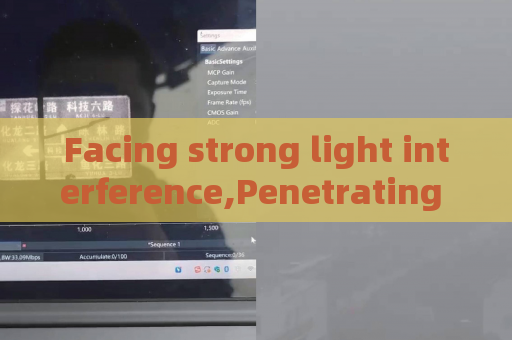
Facing strong light interference, Penetrating Imager relies on Strong Light Suppression Imaging to stabilize law enforcement imaging At vehicle checkpoints and tactical stops, law enforcement imaging often collapses when intense light floods the scene. Headlights, roadside lamps, low sun, reflective plates, and tinted glass create glare, blooming, and sensor saturation. The camera exposes for the bright source while the vehicle interior falls into shadow. Surface reflections from windscreens and side windows can hide occupants, hand positions, and cabin layout. The result is unstable video, delayed threat assessment, and weaker visual records. This is not a minor exposure issue; it is an operational safety problem. At night, high beams and reflective markings intensify the problem, producing halos around sources and darkening the cabin further. A momentary glimpse is often insufficient for reliable assessment. The operational demand is clear: a Penetrating Imager must hold law enforcement imaging stable when strong light interference dominates the scene. The relevant capability is Strong Light Suppression Imaging inside the Penetrating Imager. This advanced optical imaging instrument uses laser range-gated imaging, also called gated imaging. It is an active imaging system built from a high-repetition-rate pulsed laser, an image-intensified gated camera with an MCP image intensifier, high-voltage module, timing module, a beam expander, and an imaging lens. The camera gate opens only for a very short interval synchronized with the laser pulse returning from the target plane. Continuous ambient light, headlight glare, and backscatter from the outer glass surface are largely rejected before they can wash out the image. Because the illumination is pulsed and time-gated, the system separates light returning from the chosen depth from light scattered by the atmosphere or glass surface. This separation keeps the image stable rather than blooming under strong light. The method delivers high-contrast imaging, long working distance, high resolution, strong anti-interference, and effective suppression of backscatter. Through optical media such as vehicle windows, train windows, aircraft portholes, and glass curtain walls, it supports through-glass surveillance. It does not penetrate opaque solid barriers and remains purely an optical tool. It can also maintain clarity through fog, haze, rain, and snow; fire-scene visibility can improve by 3–5 times, though dense smoke remains a limit. In the vehicle scenario, the function turns a reflective windscreen from a barrier into a usable optical path. Operation at a checkpoint is direct. The Penetrating Imager is mounted on a vehicle or tripod and aimed at the target vehicle. The pulsed laser illuminates the glass and cabin; the gated camera collects only the returning light within the selected range slice. Strong Light Suppression Imaging prevents headlights and reflections from dominating the frame. The range gate can be adjusted to match the distance to the target glass and cabin, while gain and timing settings keep the interior within usable contrast. Under rapid changes from shadow to headlight glare, the image does not collapse into a white flare or black silhouette. Law enforcement personnel can observe seat occupancy, hand movement, and cabin conditions through tinted or reflective windows while the vehicle is still approaching or holding at the stop line. The image remains stable across changing light, which supports faster tactical decisions, clearer documentation, and safer control of the encounter. The same optical behavior applies to fixed checkpoints, mobile patrols, and temporary observation posts where vehicles pass through mixed lighting. In practical use, multiple glass layers, tinted films, and angled reflections can still challenge any optical system. Range gating and narrow timing windows reduce the influence of glare and surface scatter, preserving contrast on the cabin plane. The Penetrating Imager does not remove the need for lawful procedure, physical inspection, or tactical caution. It provides a clearer optical view through vehicle glazing when strong light interference would otherwise destabilize law enforcement imaging. Where windows are heavily tinted or coated, the system still depends on light returning through the glazing; performance varies with glass type and angle. Yet the core advantage remains unchanged: Strong Light Suppression Imaging holds the image steady when ordinary cameras fail under strong light interference. The Penetrating Imager therefore functions as a focused optical aid for through-window tactical observation, not as a general search device. Strong Light Suppression Imaging in the Penetrating Imager keeps law enforcement imaging stable under strong light interference.




