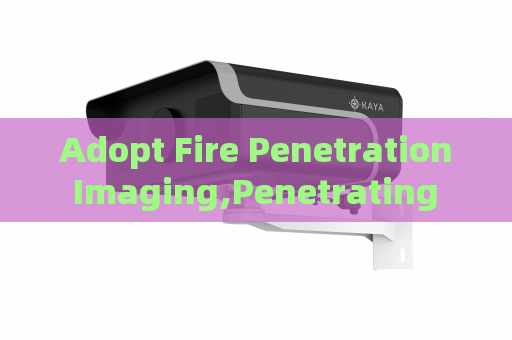
Adopt Fire Penetration Imaging, Penetrating Imager serves building exterior fire observation to collect fire situation information Building exterior fire observation is often degraded by intense flame glare, heat shimmer, water spray, rain, fog, and reflections from glass curtain walls or windows. Incident commanders positioned outside a safe perimeter need dependable fire situation information: active flame locations, spread across a façade, window or glazing failure, and visible conditions behind windows. Ordinary cameras and direct visual checks saturate in bright fire light, lose edge definition, and suffer from backscatter. Glass surfaces add mirror-like reflections that obscure interior visibility. The operational problem is optical rather than structural. Adopt Fire Penetration Imaging, Penetrating Imager serves building exterior fire observation to collect fire situation information by creating a clearer optical channel through fire, weather, and glazing. The Penetrating Imager is an optical instrument limited to optical media; it does not turn solid walls into transparent surfaces. That boundary is essential for correct use at a building fire. The capability that addresses this scene is laser range-gated imaging, also called gated imaging. The Penetrating Imager is an active optical system built around a high-repetition-rate pulsed laser, a beam expander, an image-intensified gated camera with an MCP image intensifier, a high-voltage module, a timing module, and an imaging lens. Short laser pulses travel toward the target. The camera gate opens only for returning light that arrives within a selected time slice. This mechanism rejects backscatter from flame glare, rain, fog, haze, and water droplets while preserving high-contrast light from the chosen depth. Fire Penetration Imaging allows building exterior fire observation through fire, fog, haze, rain, and snow, and through optical media such as window glass and glass curtain walls. The system provides long range, high resolution, strong anti-interference performance, and effective backscatter suppression. It is not effective against dense smoke, and it cannot penetrate walls, concrete, brick, metal, wood, or clothing. The function solves the exterior observation problem by restoring optical contrast where conventional imaging fails. During an incident, the Penetrating Imager can be mounted on a tripod, vehicle, or portable platform outside the building. The operator aims it at a façade, a glass curtain wall, or a specific window and adjusts gate delay to select the depth of interest, such as beyond the flame front or beyond the glazing. The image can reveal flame boundaries, window breakage, cladding damage, and visible interior fire indicators through glass. Fire scene visibility can improve three to five times compared with unaided or conventional observation under the same optical interference. Video or still images are relayed to the incident command post, where they support sector assignment, exposure protection, and ventilation decisions. Dense smoke remains a hard limit. The tool is used where glass and fire-related optical interference dominate the line of sight, not where solid construction blocks the view. Repeated scans from different exterior angles can collect fire situation information over time. The Penetrating Imager can monitor a glass curtain wall sector while rain, fog, or water spray degrades ordinary optics. Changes in flame position, glass failure, and interior glow behind windows can be recorded and compared. This supports a more complete exterior fire picture before crews enter or while defensive operations continue. The Penetrating Imager remains an optical instrument: its advantage is clear imaging through flames, atmospheric obscurants, and glass, not through solid construction. Used within that boundary, it strengthens building exterior fire observation and helps collect fire situation information with greater contrast, range, and reliability.




