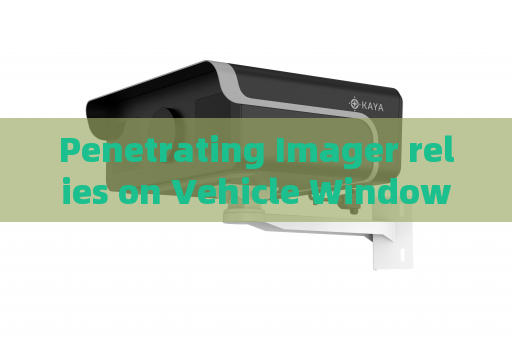
Penetrating Imager relies on Vehicle Window Penetration, supports urban night law enforcement for hidden target monitoring Urban night law enforcement often confronts a specific tactical problem: identifying hidden targets inside vehicles without opening doors, lighting the cabin, or exposing officers to unknown risk. Tinted automotive glass, reflective coatings, rain-slicked surfaces, glare from headlights and streetlamps, and deep shadows can turn a routine stop into an information gap. A subject may remain concealed behind glass while posture, movement, or hand position cannot be assessed from a safe distance. Standard visual checks may require approaching the vehicle, which can alert the subject, compromise timing, and reduce scene control. The Penetrating Imager relies on Vehicle Window Penetration, supports urban night law enforcement for hidden target monitoring, giving officers a way to observe through automotive glazing while maintaining standoff. The operational demand is not merely seeing through glass; it is obtaining a stable, high-contrast image at night, through reflective and tinted media, without disturbing the target or the surrounding environment. The need is acute when time is short, legal thresholds are strict, and a wrong assumption can escalate a stop into a dangerous encounter. The relevant capability is laser range-gated imaging, an active optical method that uses a high-repetition-rate pulsed laser, a gated image-intensified camera with an MCP image intensifier, high-voltage and timing modules, a beam expander, and an imaging lens. Short laser pulses illuminate the vehicle. The camera gate opens only for the brief return window corresponding to the target distance, so light scattered by the outer glass surface, rain, fog, snow, and ambient illumination is largely rejected. This produces high-contrast imaging through vehicle windows, including tinted glass, while preserving detail in low-light conditions. This makes tactical observation through automotive glass possible from a patrol vehicle, a concealed position, or a temporary observation point. The system supports covert through-glass recon and see-through vehicle glass imaging without requiring the cabin to be lit or the door to be opened. Strong light suppression keeps headlights, streetlights, and reflective glazing from washing out the scene. Reflective layers on modern automotive glazing can otherwise mirror the street and hide the cabin, while dark interiors can absorb what little light remains. In practice, an operator can aim the Penetrating Imager at a suspect vehicle and monitor occupants, movement, and visible objects through the windows. The pulsed laser and gated camera work together to create a real-time or near-real-time image on a display. During urban night operations, this allows officers to confirm whether a vehicle is occupied, observe a hidden target’s posture, and coordinate an approach with better situational awareness. The imager can be used from a stationary checkpoint, a mobile patrol platform, or a fixed observation post. Rain, fog, and snow do not necessarily end the observation, because the range-gated method reduces backscatter and keeps the target return distinct. Tinted windows and laminated automotive glazing remain within the optical path. The result is improved decision-making before contact, reduced surprise, and stronger officer safety. The display can be recorded or relayed to a supervisor, helping document what was visible through the glass before any contact. The same operational discipline applies across multiple vehicles and changing street conditions. The Penetrating Imager can scan a row of parked cars, examine a vehicle stopped at a curb, or maintain watch on a target vehicle in a dark lot. Its vehicle window penetration function is limited to optical media such as automotive glass and similar transparent or tinted glazing. It does not replace physical search or legal authority. It provides a tactical visual advantage: a clearer view through glass at night, without alerting the subject. For urban night law enforcement, hidden target monitoring becomes faster, safer, and more precise. The Penetrating Imager relies on Vehicle Window Penetration, supports urban night law enforcement for hidden target monitoring, and keeps the observation focused on the optical pathway that matters most: the vehicle window. This keeps the method within its proper optical limits and aligned with lawful, targeted observation.




