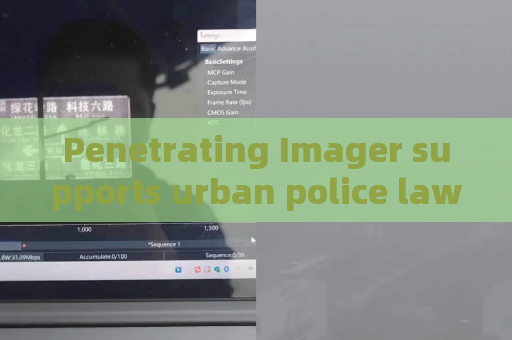
Penetrating Imager supports urban police law enforcement, utilizes Through-glass Imaging Technology to detect hidden vehicle risks Urban police law enforcement frequently meets vehicles that cannot be assessed safely from the outside. A car parked near a venue, a van stopped at a checkpoint, or a vehicle linked to a call for service may have tinted windows, reflective glazing, rain streaks, fog, or harsh streetlight glare across the glass. Occupants, seating positions, objects held below window level, and signs of distress or aggression can remain concealed. A conventional flashlight check offers little against deep tint or strong reflection. Opening a door or breaking glass creates tactical risk and may escalate a routine stop. The Penetrating Imager is designed for this exact gap: a standoff optical tool that helps officers detect hidden vehicle risks before closing distance. Through-glass Imaging Technology provides a clearer view of what the glazing obscures, without turning a traffic contact into a forced entry. In dense city conditions, the problem is not only darkness. Bright signs, wet glass, and layered reflections can hide a passenger, a weapon held low, or an unexpected movement in the rear cabin. Officers need a way to observe before acting. The relevant function is active laser range-gated imaging, also known as gated imaging. The Penetrating Imager emits short pulses of light from a high-repetition-rate pulsed laser. An image-intensified gated camera, containing an MCP image intensifier, high-voltage module, and timing module, opens its shutter for a precise interval. A beam expander and imaging lens shape and collect the returned light. Because the system controls when the camera receives light, it suppresses backscatter from rain, fog, haze, dust, and reflective glass. This optical design delivers high-contrast, high-resolution imagery at distance and resists interference. A tactical visual check through tinted windows becomes possible because the imager works only through optical media such as vehicle glazing. It does not image through opaque structural materials or vehicle body sections. The active system supplies its own illumination, so ambient light is not the deciding factor. For urban police law enforcement, the value is a rapid, non-intrusive look at the passenger compartment under conditions that defeat unaided vision. Through-glass Imaging Technology also helps distinguish interior shapes from window reflections, allowing a clearer assessment of occupancy and posture. In field use, an officer or remote operator can mount the device on a patrol vehicle, checkpoint stand, or tripod and aim it at a selected window. The laser light passes through the glass, strikes occupants or interior surfaces, and returns to the gated camera. The timing gate rejects light scattered by the window surface and atmospheric particles, producing an image of the interior rather than a blur of glare. This allows assessment of whether a vehicle contains one person or several, whether hands are visible, whether a passenger is slumped, reaching, or holding an object, and whether the rear compartment appears occupied. The result supports decisions about approach, cover, verbal commands, medical response, or additional units. At a row of stopped vehicles, the process can be repeated window by window, giving supervisors a clearer picture of hidden vehicle risks without ordering unnecessary door openings. Rain, fog, and low light do not automatically defeat the view, and strong light suppression helps when streetlights or headlights wash across the glass. A recorded image can be shared with a tactical commander, preserving a common view of the scene before contact. If the glass is heavily tinted, the imager can still provide useful contrast by controlling illumination and gate timing, though image quality depends on angle, distance, and surface condition. Operational limits remain part of the same scene. The Penetrating Imager depends on a clear optical path through vehicle windows, and performance can vary with severe tint, dirt, cracks, acute angles, or distance. It is an optical imaging instrument, not a tool for opaque barriers. Its laser range-gated design keeps the method within light-based observation, using pulsed illumination and gated reception to overcome backscatter and reveal what is behind glazing. In urban police law enforcement, this supports a measured response: officers gain time, reduce surprise, and focus attention on vehicles that present hidden vehicle risks. The Penetrating Imager supports safer stops, clearer tactical decisions, and more informed action at the window before contact begins.




