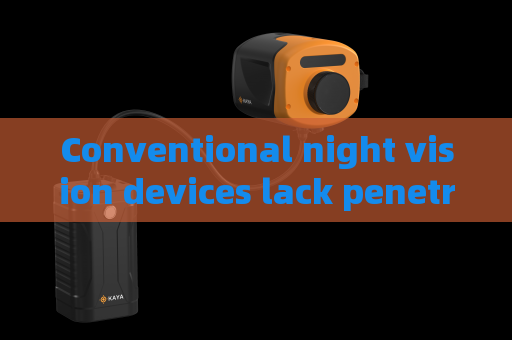
Conventional night vision devices lack penetration capability, Penetrating Imager adapts glass and fog environments for effective tactical observation Conventional night vision devices lack penetration capability, and the problem becomes critical during covert observation of a vehicle interior at night or in fog. A tactical team may have a lawful need to assess occupants, hand positions, seat count, or movement inside a stopped or parked car without approaching and exposing its position. Automotive glass forms an optical barrier. Tinted panes, reflective coatings, streetlight glare, and interior darkness reduce the contrast available to image-intensified night vision. Fog adds scattering that washes out detail and creates backscatter. The operator sees bright haze, window reflections, and vague shapes, while critical interior features disappear. The difficulty increases when windows are closed, interior lights are off, and the vehicle sits in a low-visibility corridor. The Penetrating Imager is designed for this exact optical challenge, using active light and range gating to recover detail through glass and adverse atmospheric media. The relevant function is laser range-gated imaging. A high-repetition pulsed laser illuminates the scene, and an image-intensified gated camera with an MCP, high-voltage module, and timing module opens its shutter for a very short interval. The delay is synchronized to the target distance, so light returning from the selected range is accepted, while light scattered from the glass surface, fog, rain, snow, or haze is rejected. A beam expander and imaging lens shape the illumination and collect the return. The MCP intensifies weak interior returns, while the high-voltage module drives the intensifier and the timing module controls the gate with precision. This active optical design produces high-contrast images with long range, high resolution, and strong anti-interference performance. The system penetrates only optical media such as vehicle windows, train windows, aircraft windows, and glass curtain walls, and it can image through fog and similar atmospheric obscurants. For through-window tactical observation, the gate can be placed just beyond the glass so that interior returns dominate the image. In practice, the device is mounted on a tripod or vehicle platform and aimed at the target car from a covered position. Range calibration is adjusted until the selected slice falls inside the passenger compartment. Surface reflections from the windshield or side window are suppressed, and the interior appears with higher contrast. Occupant silhouettes, posture, and hand movement become easier to interpret. In fog, the same timing control rejects much of the scattered light that would otherwise hide the vehicle. The result is a clearer tactical picture without moving closer to the target. Through-glass surveillance can continue while the observation team remains at standoff distance, and the image can support real-time decisions about approach, containment, or withdrawal. Multiple windows can be checked by shifting aim and resetting the range gate, allowing a rapid visual survey of the cabin. The operational value lies in reducing uncertainty before contact. A vehicle stopped in fog with dark tinted glass often presents an ambiguous threat picture. Conventional night vision may show the exterior shell but not the people or objects behind the glass. A Penetrating Imager changes the quality of that observation by isolating the interior return and suppressing glare and backscatter. It can help confirm whether a driver is seated, whether passengers are moving, or whether the cabin appears occupied. The system remains an optical tool with a strict boundary: it works through glass and atmospheric obscurants, not through opaque vehicle bodywork, and it does not replace physical search or established tactical procedures. In glass-and-fog environments, however, it provides the missing visual access that conventional night vision devices lack, making tactical observation more informed and safer. The Penetrating Imager offers a focused solution for standoff inspection of vehicle interiors when glass and fog defeat standard night vision.




