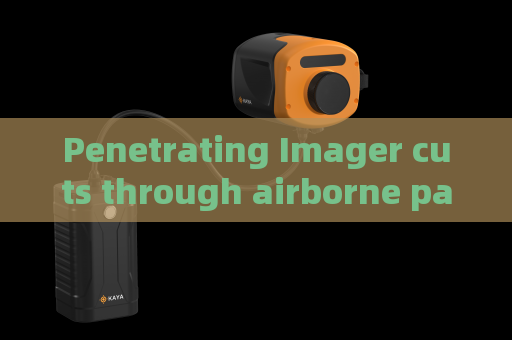
Penetrating Imager cuts through airborne particles to deliver sharp target outlines in heavy fog and smoke conditions In emergency and police reconnaissance, heavy fog and smoke-laden air create a punishing optical environment. Water droplets, soot, dust, and other airborne particles scatter light in every direction before it reaches a camera. Ordinary optical systems collect that scattered return, washing out contrast and turning a human silhouette, vehicle profile, or abandoned object into a soft gray shape. The result is delayed decisions, missed targets, and unsafe movement in low-visibility corridors, highways, ports, and fireground perimeters. Without reliable outlines, cordons drift, evacuation routes become guesswork, and responding units lose the visual confidence needed for safe contact. The Penetrating Imager is built for this exact tactical problem: restoring a usable target outline when airborne particles would otherwise obscure the scene. For the Penetrating Imager, the target is not a brighter scene but a recognizable outline. The requirement expressed in the title is therefore operational, not cosmetic; sharp edges matter when a team must distinguish a person from a pole, a vehicle from a barrier, or a moving figure from background clutter. The relevant function is laser range-gated imaging, also called gated imaging. The Penetrating Imager is an active optical system. A high-repetition-rate pulsed laser sends short light pulses into the scene through a beam expander. An image-intensified gated camera, containing an MCP image intensifier, high-voltage module, timing module, and imaging lens, opens its gate only for a brief, selected time window. Light returning from the target distance is amplified; light scattered back by nearby fog, haze, rain, snow, or airborne particles arrives outside that window and is largely rejected. This range discrimination is the heart of Fog Penetration Imaging. It raises contrast, reduces backscatter, preserves edge definition, and allows long-range, high-resolution viewing under conditions that defeat conventional optical observation. The system remains an optical imager; its strength is management of optical scattering, not penetration of opaque solid barriers. Field use follows a disciplined sequence. A tripod, vehicle mount, or fixed post holds the unit steady while the operator scans the sector. The timing module is adjusted to the estimated target distance, and the pulsed laser illuminates the field of view. On the display, the foreground fog or smoke veil loses much of its glare, while the selected range returns a sharper target outline. In coastal fog, an emergency team can track a missing person along a seawall or search a shoreline without losing the figure in gray mist. On a highway in dense fog, police can identify vehicle shapes and pedestrian positions before approaching. At an industrial fire, where smoke mixes with steam and airborne ash, the Penetrating Imager can improve visibility and support evacuation, but dense smoke remains a hard limit; the tool does not defeat a dense smoke column. The practical gain is faster recognition, better spatial awareness, and safer tactical movement without relying on visible-light cameras alone. The operational value continues in command and control. Range-gated imaging allows repeated observation of the same sector, so incident commanders can compare target outlines over time and direct resources with greater confidence. It supports covert observation when visible illumination would be unsafe, and it can be paired with recording for after-action review. Performance still depends on optical conditions: fog, haze, rain, snow, and fire-generated particulate can be managed, while dense smoke blocks the optical return and cannot be overcome. For that reason, the Penetrating Imager is best understood as a precision optical instrument for reconnaissance in particle-heavy air, not as a universal see-through device. In this role, the Penetrating Imager supports the narrow but critical mission of optical reconnaissance when particles fill the air, and it keeps expectations aligned with physics. When the air is filled with scattering media and a sharp target outline is the difference between action and hesitation, the Penetrating Imager provides the contrast needed to decide.




