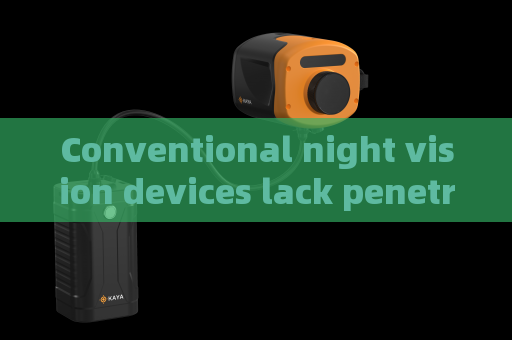
Conventional night vision devices lack penetration capability, Penetrating Imager adapts glass and fog environments for effective tactical observation During night vehicle stops and covert surveillance in fog, teams often need to assess occupants and potential threats through closed side windows. Conventional night vision devices lack penetration capability. Image intensifiers and low-light cameras can reveal reflected light, yet glass remains an optical barrier: tinted panes, laminated safety glass, rain films, and fog produce glare, haze, and low contrast. A conventional device may show the window frame and exterior reflections, while the interior remains a vague silhouette. Approaching a suspect vehicle to look inside with a handheld light destroys concealment and compresses reaction time. The operational problem is not only darkness; it is the inability to form a reliable image through glass while fog and weather scatter light. Penetrating Imager addresses this specific gap by adapting to glass and fog environments for effective tactical observation, allowing a team to inspect a vehicle cabin from a protected distance before deciding on contact. The relevant capability is laser range-gated imaging, often called gated imaging. A Penetrating Imager is an active optical system built around a high-repetition-rate pulse laser, an image-intensified gated camera with an MCP image intensifier, high-voltage module, timing module, beam expander, and imaging lens. Short laser pulses illuminate the scene, and the camera gate opens only for a narrow time slice corresponding to a selected distance. Light returning from the glass surface, fog droplets, rain, or haze is rejected before it can wash out the image. The result is high-contrast imaging with long range, high resolution, strong anti-interference performance, and effective suppression of backscatter. In the vehicle-check scenario, this enables through-window tactical observation through automotive glass in fog. The system works with optical media such as vehicle windows. It is not designed for opaque solids such as walls, metal, or clothing. In practice, the unit can be mounted on a tripod or vehicle and aimed at a suspect car. The operator selects a range gate beyond the exterior glass surface, so the gate ignores reflections from the pane and backscatter from fog. The pulse laser illuminates the cabin, and the gated camera captures a high-contrast return from seats, occupants, hands, and objects. Observation can remain covert because no white light is used and the laser pulse is brief. The same setting supports tactical visual check through tinted windows when fog, haze, rain, or snow reduce ordinary camera performance. A checkpoint team can confirm whether a vehicle is occupied, whether hands are visible, or whether a person is reaching toward a concealed area. The image is not a guess based on reflected ambient light; it is an optical return from the selected depth. This changes the decision cycle from risky close approach to distant verification. The operational value in this scenario is reliable through-glass surveillance under poor visibility. A Penetrating Imager cannot see through opaque vehicle bodies, and it does not defeat dense smoke. Its function is limited to optical media and weather conditions that scatter or reflect light. Within those limits, the ability to reject surface glare and fog backscatter gives officers a clearer view of the cabin than conventional night vision devices. Vehicles with reflective or tinted glazing no longer force an immediate close inspection. Commanders can place the imager at a safe distance, monitor occupants, and coordinate movement only when the tactical picture is clear. For night vehicle intercepts in fog, the Penetrating Imager turns an uncertain exterior silhouette into a usable interior image, and that difference directly supports safer, more informed decisions at the scene.




