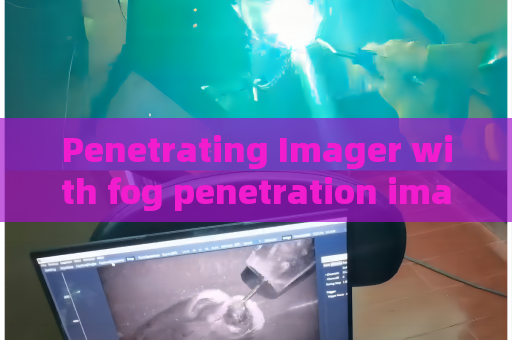
Penetrating Imager with fog penetration imaging capability for foggy checkpoint duty to maintain stable imaging output At a foggy checkpoint, the operational problem is not merely reduced visibility. Fog droplets scatter light in multiple directions, vehicle headlights create blooming glare, and backscattered light washes out lane detail. Ordinary cameras and direct-view optics produce unstable images whose contrast changes with fog density, distance, and angle. Vehicle outlines become soft, window glass behaves like a reflective curtain, and occupants or suspicious objects inside a vehicle are difficult to assess. Screeners must slow the lane, repeat visual checks, and rely on close-range inspection. A Penetrating Imager designed for foggy checkpoint duty is intended to maintain stable imaging output, so lane observation remains usable when optical interference is present. The relevant function is an advanced optical imaging instrument based on laser range-gated imaging, also called gated imaging. It comprises a high-repetition-rate pulsed laser, an image-intensified gated camera with an MCP image intensifier, high-voltage module, and timing module, a beam expander, and an imaging lens. As an active imaging system, it provides high-contrast imaging with long operational range, high resolution, strong anti-interference, and effective suppression of backscattering. Fog Penetration Imaging works by sending short laser pulses into the checkpoint lane and opening the camera gate only for light returning from a selected distance. Scattered light from fog droplets arrives earlier and is largely rejected, while light reflected from vehicles, occupants, and window glass at the chosen range is collected. The timing module coordinates laser emission and camera gating with microsecond precision, and the high-voltage module drives the MCP image intensifier for sufficient gain under low return. This range-gated optical process keeps edges and target contrast stable as fog density shifts. The instrument is limited to optical media such as vehicle window glass, train window glass, aircraft portholes, glass curtain walls, and atmospheric media including fog, haze, rain, and snow. Opaque solid materials remain outside its imaging scope. In checkpoint operation, the unit can be mounted on a lane gantry or vehicle platform and aligned with the screening zone. The pulsed laser illuminates the lane, and the gated camera is timed to the distance of the stop line, inspection bay, or approaching vehicle. The beam expander shapes the illumination across the lane, while the imaging lens and image-intensified camera deliver a view to the operator display. When a vehicle enters the checkpoint, the system maintains stable imaging output instead of letting fog haze erase the vehicle contour. Through-window observation of the cabin becomes possible because vehicle glass is an optical medium within the instrument’s scope, allowing a tactical visual check of seat occupancy, posture, and visible cabin features without opening the door. The effect is faster screening, fewer repeated checks, and clearer lane awareness under fog, haze, rain, or snow. Fog density at a checkpoint is rarely constant. It changes with time, wind, traffic, and temperature, and rain or snow can add further optical scattering. A system that depends on ambient light or simple camera exposure will drift between washed-out frames and dark, noisy images. The Penetrating Imager uses active laser illumination and gated reception to hold contrast and detail across these shifts. The operator can adjust gate delay to match a lane position and keep the return window narrow, so fog backscatter is suppressed while the target remains visible. A narrow gate also reduces interference from lane lights and reflective signs, keeping the visual field focused on the selected range. Consistent image output supports continuous duty: vehicles can be monitored from a distance, cabin checks through window glass can be conducted with consistent clarity, and suspicious visual cues can be evaluated before close contact. The instrument does not claim penetration of opaque solid materials; its function is confined to optical media such as glass and atmospheric fog, haze, rain, and snow. This limitation keeps the checkpoint role precise: reliable optical reconnaissance in fog, not penetration of solid structures.




