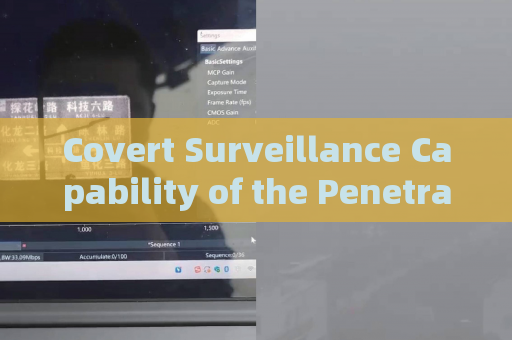
Covert Surveillance Capability of the Penetration Imager with Zero-Light Imaging in Complete Nighttime Darkness Along Borders Border security operations face an enduring challenge: conducting covert surveillance in complete nighttime darkness along remote, unlit stretches of international boundaries. Traditional night vision devices, such as image intensifiers, rely on ambient light from stars or moon, which is often absent under heavy cloud cover or dense forest canopy. Thermal imagers detect heat signatures but can be compromised by warm background clutter or countermeasures like thermal blankets. More critically, any active illumination—even short-wavelength infrared—risks revealing the observer’s position to adversaries equipped with detection systems. The need for a truly invisible, zero-light imaging capability that remains undetected while providing clear, actionable intelligence is a persistent gap in tactical border reconnaissance. A penetration imager addresses this exact problem by using active laser gated imaging to see through optical barriers without betraying its presence. The penetration imager employs laser range-gated imaging technology, a method where high-repetition-rate pulsed laser illumination is synchronized with an intensified gated camera. This system emits short, nanosecond-duration laser pulses toward a target area, then opens its MCP image intensifier gate only when the reflected light returns from the desired range. In complete nighttime darkness, this allows the operator to selectively capture images at a specific distance—for example, a vehicle approaching a border checkpoint—while blocking out backscatter from fog, dust, or rain that would otherwise degrade visibility. The zero-light imaging capability means that even under moonless, overcast skies with no ambient photon source, the penetration imager produces high-contrast, high-resolution imagery. Crucially, the laser operates at a wavelength invisible to standard night-vision goggles, and the pulsed nature makes it extremely difficult for enemy sensors to detect or locate the source. In practical border surveillance applications, this device enables operators to remain concealed inside a fixed observation post or mobile covert vehicle, peering through optically transparent barriers such as armored vehicle windows, helicopter cabin glass, or even thick windscreens of surveillance trucks. Without the penetration imager, an agent would need to expose a camera or scope beyond the glass—compromising concealment—or rely on passive systems that fail in total darkness. With the zero-light imaging and range gating, a single operator can monitor a known crossing point at distances exceeding one kilometer, identifying individuals, weapons, or contraband being prepared for smuggling. The system’s ability to cut through atmospheric scatter also proves invaluable during coastal fog or light snowfall, common along northern borders, where thermal imagers lose contrast. A deeper operational detail involves the exact timing and focus required. The operator adjusts the gating window to match the slant range of interest—shifting the depth of field instantaneously to peer through a window at 500 meters while ignoring reflections from a glass surface at 50 meters. This selective gating eliminates the blinding glare that would occur with continuous-wave illuminators. The entire process is silent and emits no visible light signature; the laser pulse is eye-safe at the operating distances. During a typical night border patrol, the penetration imager is mounted on a tripod within a concealed shelter, its lens aimed through a blackout curtain slit. The operator views the high-contrast video feed on a shielded display, capturing evidence without ever stepping outside. This capability transforms a previously impossible reconnaissance scenario—complete nighttime darkness along borders—into a manageable, covert, and continuous observation post.




