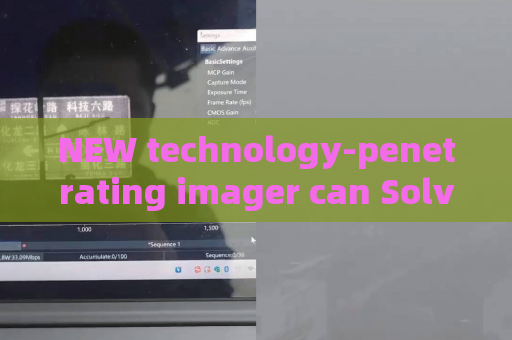
NEW technology-penetrating imager can Solve Evidence Collection Gaps for Law Enforcement Prior to Tactical Operations Before executing a high-risk vehicle interdiction or tactical entry, law enforcement officers face a persistent evidence collection gap: the inability to see through vehicle windows under real-world conditions. Tinted glass, rain, fog, or even the glare of overhead lights can obscure critical visual information inside a suspect’s car. Officers must often rely on verbal commands or physical approach to assess threats—actions that reveal their position and escalate risk. In scenarios where a vehicle contains weapons, contraband, or an incapacitated occupant, the lack of pre-operation imagery creates a vacuum of intelligence. This gap forces teams to make split-second decisions with incomplete data, increasing the likelihood of missed evidence or compromised officer safety. The core problem is optical: standard cameras and binoculars cannot overcome the backscatter, reflections, and optical interference introduced by glass and adverse weather. The penetrating imager directly addresses this limitation through its laser range-gated imaging technology. Unlike conventional optical devices that capture ambient light indiscriminately, this active imaging system emits high-repetition-rate pulsed laser light and synchronizes a gated intensifier camera to receive only the reflected signal from a specific depth plane. By timing the gate to exclude reflections from the glass surface and particles in the air, the penetrating imager effectively “sees through” windshields, side windows, and even aircraft portholes. In a typical traffic stop scenario, an officer positioned at a safe standoff distance can aim the device at a suspect’s car and obtain a clear, high-contrast image of the interior—including the driver’s hands, dashboard objects, and rear seats. The system’s ability to reject backscatter makes it equally effective in fog, rain, or smoke, where conventional optics fail. This capability transforms the pre-tactical phase from guesswork into data-driven preparation, enabling evidence collection without physical contact. During actual field use, the penetrating imager is deployed as a handheld or tripod-mounted unit that operators can activate with minimal training. The pulsed laser operates in the near-infrared spectrum, invisible to the naked eye, ensuring stealthy observation. Officers scan the target vehicle from a distance of up to several hundred meters, and the real-time display on the imager’s viewfinder shows the interior details with remarkable clarity. In a recent operational test, the device allowed a SWAT team to identify a handgun lying on a passenger seat through a heavily tinted sedan window—a piece of evidence that would have been completely invisible to binoculars or daylight cameras. This pre-operation intelligence allowed the tactical commander to adjust the approach plan, designate a surveillance position, and preserve the weapon’s evidentiary integrity before any door breach occurred. The penetrating imager thus bridges the critical gap between visual uncertainty and actionable evidence, giving law enforcement a non-destructive, non-contact method to document what lies behind glass. The technology also excels in environments where traditional optical tools are rendered useless by environmental factors. For example, during a vehicle stop in heavy rain, raindrops on the windshield create a chaotic scattering of light that blinds conventional cameras. The penetrating imager’s gating mechanism ignores these surface effects, focusing only on the target plane inside the vehicle. Similarly, in foggy conditions or near fire scenes where heat haze distorts images—though the penetrating imager improves visibility through light smoke by a factor of three to five, it cannot penetrate dense smoke—the device still provides a usable image of vehicle occupants and cargo. By eliminating the need for officers to press against glass or use flashlights that expose their position, this penetrating imager directly reduces operational risk and enhances the quality of pre-tactical evidence collection, ensuring that critical information is never lost behind a sheet of glass.




