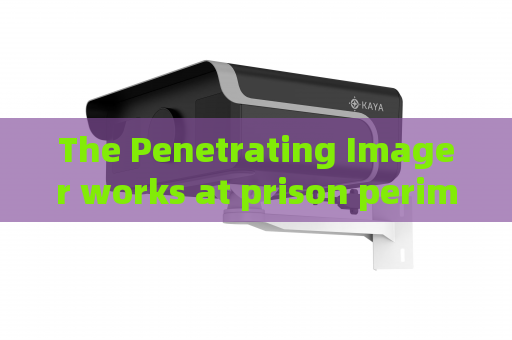
The Penetrating Imager works at prison perimeter zones with Low-light Imaging. This scenario presents a persistent challenge for correctional security teams: monitoring inmate activity along fence lines and near vehicle entry points during darkness or adverse weather. Conventional CCTV systems struggle with low ambient light, often producing grainy, indiscernible images that fail to capture subtle movements. Prisoners exploit these blind spots, using tinted windows of patrol vehicles, glass-panelled observation booths, or even reflective surfaces to conceal illicit behavior such as contraband exchange or escape planning. The inability to see through automotive glass or detect unauthorized activity inside a stationary guard car undermines perimeter integrity. Officers must rely on intrusive spotlights that alert inmates and compromise covert operations. The need for a non-intrusive, high-contrast imaging solution that functions in extreme low-light conditions without revealing the observer’s position is critical. The Penetrating Imager addresses this operational shortfall through its advanced laser range-gated imaging technology. Unlike passive night vision, this active optical system emits a high-repetition pulsed laser synchronized with an intensified gate camera. The device selectively captures light reflected from a target while rejecting backscatter from fog, rain, or intervening glass surfaces. In prison perimeter zones, the key function is through-glass covert observation: the imager penetrates standard vehicle windows, security glazing, and even heavily tinted automotive glass that defeat ordinary cameras. Low-light Imaging capability allows the operator to see clearly inside a parked patrol car or a prison workshop window from distances exceeding 300 meters, all while the laser remains invisible to the naked eye. The system’s high-resolution MCP image intensifier amplifies available photons, producing crisp, high-contrast video that distinguishes facial features, hand movements, and objects hidden behind glass. On patrol, a security officer can deploy the Penetrating Imager from a concealed position near the perimeter fence. The lightweight unit mounts on a tripod or vehicle roof, and a handheld controller adjusts the gate timing to match the target distance. During a routine night check, the operator scans the line of staff vehicles parked inside the secure zone. Through the tinted rear window of a van, the imager reveals two inmates crouched behind seats, exchanging a bundle. The Low-light Imaging mode eliminates the need for floodlights, preserving tactical surprise. Simultaneously, the system suppresses glare from distant streetlights or reflective surfaces, maintaining clear vision without blooming. This operational method transforms a previously vulnerable perimeter segment into a fully monitored zone, enabling intervention before an incident escalates. The device further excels in mixed-weather conditions common at outdoor prison perimeters. Heavy fog or drizzle that blinds traditional thermal imagers does not degrade the Penetrating Imager’s performance; it actively gates out scattering particles, providing a sharp view through mist and light rain. Even when smoke from a nearby controlled burn drifts across the fence line, the imager maintains 3–5 times better visibility than the human eye in fire-affected areas, though dense smoke remains a limitation. Officers can thus maintain continuous surveillance during shift changes, inmate movements, and perimeter patrols without leaving the observation post. The combination of long-range, glass-penetrating capability and low-light enhancement ensures that prison security teams gain a decisive tactical advantage in the most challenging nocturnal environment, reinforcing the perimeter’s integrity without compromising covert operations.




