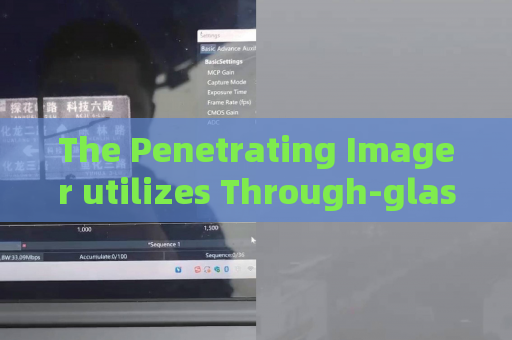
The Penetrating Imager utilizes Through-glass Imaging Technology to track target vehicles in joint military-police patrols. During joint military-police patrols, tracking target vehicles presents a persistent and critical challenge. Suspects often employ heavily tinted or reflective automotive glass to conceal illegal cargo, weapons, or individuals inside the vehicle. Standard optical surveillance equipment—binoculars, spotting scopes, or even high-resolution cameras—cannot penetrate these glass surfaces under normal conditions. Rain, fog, or mist further degrade visibility, creating blind spots that allow target vehicles to escape visual tracking or move through checkpoints without being effectively inspected. The conventional approach requires officers to physically approach the vehicle, risking exposure, escalation, or ambush. The inability to see through vehicle glazing from a safe standoff distance remains a genuine operational pain point for patrols that must maintain both tactical surprise and personal safety. The Penetrating Imager directly addresses this problem through its laser range-gated imaging technology. Unlike passive optics that rely on ambient light, this active imaging system uses a high-repetition-rate pulsed laser coupled with an intensified gated camera. The camera incorporates a microchannel plate (MCP) intensifier, a high-voltage module, and precise timing circuitry. By emitting short laser pulses and opening the camera shutter only when the reflected light from the target returns, the system rejects backscatter from fog, rain, or dirty windshields. This gating effect enables the imager to produce high-contrast images of objects behind automotive glass, even when the glass is heavily tinted or coated. The device is strictly limited to optical transparent media—such as car windows, train windows, aircraft windows, or glass curtain walls—and has no capability to penetrate solid barriers like walls, concrete, or metal. It also performs reliably in smoke-free fire scenes, enhancing visibility by three to five times, though dense smoke remains outside its operational envelope. In practical joint patrol applications, the Penetrating Imager enables through-window tactical observation from distances that keep operators out of immediate danger. A patrol unit can position the imager on a tripod or vehicle mount several dozen meters away from the suspect vehicle. The operator aims the device at a specific window, adjusts the gate timing to match the distance, and instantly obtains a clear image of the vehicle’s interior. Occupants, tools, weapons, or contraband become visible without any physical approach. The system’s active illumination works equally well in low-light or zero-light conditions, making it effective during nighttime patrols. Because the laser operates in the near-infrared spectrum, the observation remains covert—the target does not detect the imaging activity. This capability transforms a high-risk close-quarters inspection into a safe standoff reconnaissance task, preserving the element of surprise for any subsequent interdiction. The Penetrating Imager also supports rapid decision-making during fluid patrol scenarios. When a target vehicle stops at a traffic light or pulls over, the observer can instantly check whether the driver is alone, whether passengers are moving, or whether hidden compartments exist. The device’s high resolution allows identification of small objects like cell phones, firearms, or drug paraphernalia resting on seats or floorboards. In joint military-police operations where coordination is critical, the imaging data can be relayed to command vehicles or handheld monitors via wireless link, enabling real-time tactical assessments. The imager’s ability to cut through fog, rain, and glass simultaneously ensures that even adverse weather does not compromise the mission. By focusing exclusively on through-glass imaging of target vehicles, this technology closes a long-standing gap in joint patrol surveillance, turning automotive glass from an obstacle into a transparent window for law enforcement and military forces alike.




