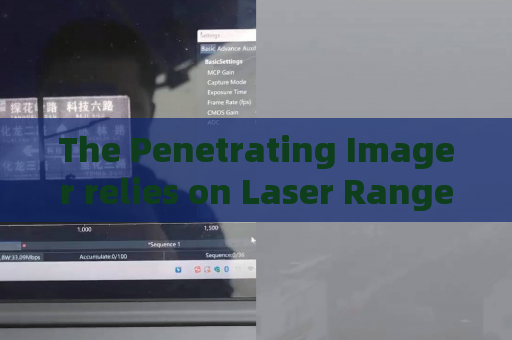
The Penetrating Imager relies on Laser Range-Gated Imaging to avoid ambient light interference in field tactical reconnaissance. Field tactical reconnaissance often requires operators to observe targets through vehicle windows, aircraft portholes, or building glass from a concealed position. Under daylight conditions, ambient light—whether direct sunlight, reflections off nearby surfaces, or glare from headlights—can severely degrade image quality. Conventional daytime optics struggle with high dynamic range: bright highlights wash out details, while shadows obscure critical features. When a suspect vehicle’s tinted windows or a helicopter’s windshield are involved, ambient light creates veiling glare that masks the interior. Worse, tactical teams must maintain covert positions; any attempt to reposition for better lighting risks exposure. The core dilemma is that ambient light, though essential for passive vision, becomes an adversary when it reflects off glass surfaces or scatters through haze, rendering standard cameras nearly useless for reliable identification. This is the real-world pain point: the need to see through a barrier of light while staying hidden. The Penetrating Imager directly addresses this problem through its core technology—Laser Range-Gated Imaging. Instead of relying on ambient illumination, the system emits short, high-repetition-rate laser pulses and synchronizes a gated intensified camera to open its shutter only when the reflected pulse from the target distance returns. This temporal gating mechanism effectively cuts off all light arriving before or after the desired range, including ambient light from the sun, moon, or artificial sources that would otherwise flood the sensor. By controlling the gate delay and width, operators can isolate the reflection from a specific plane—such as the surface of a car window or a glass facade—while reject backscatter from fog, rain, or dust. The result is a clean, high-contrast image of the scene behind the glass, even under bright sun or spotlights. For example, during through-window tactical observation, the system’s built-in timing module ensures that only the laser light returning from behind the windowpane is captured; ambient light from the window’s own reflection is gated out. This capability transforms a previously impossible task into a routine one. In practice, field operators deploy the Penetrating Imager from a discreet standoff distance—often several hundred meters away—using the integrated zoom lens to frame the target vehicle or building window. The system’s laser illuminator operates in the near-infrared spectrum, invisible to the naked eye, preserving covertness. Once powered on, the user selects the approximate range via a handheld control unit; the camera’s auto-ranging function fine-tunes the gate to the exact distance of the glass surface. Even when the target is behind heavy tint or at a shallow angle, the gating eliminates the obscuring glare. A real-world example from a night-time vehicle checkpoint scenario: ambient light from street lamps and approaching headlights created a blinding reflection on a sedan’s windshield. The Penetrating Imager, using Laser Range-Gated Imaging, captured a crisp image of the driver’s face and the rear seat occupants through the windshield, enabling positive identification without the team having to close the distance. The operator could also toggle between different gate widths to check for objects in the vehicle’s back seat or behind the rear window, all while remaining motionless behind cover. The technology also excels under mixed lighting conditions common in urban tactical environments. A suspect vehicle may be parked under a flickering neon sign, with sunlight streaming from one side and car lights sweeping across from passing traffic. The Penetrating Imager’s high-repetition-rate laser—pulsing at tens of kilohertz—averages these fluctuations, while the gating rejects any bright transient flare. The built-in Microchannel Plate (MCP) image intensifier provides sufficient gain to resolve details even when the laser return is weak due to dirty or layered glass. Operators report that the system increases fire scene visibility by 3–5 times when used through glass panels in burning buildings, though its limitation against thick smoke remains noted. Crucially, the device never relies on rays or waves beyond light—it is purely an active optical instrument. For covert teams conducting through-glass reconnaissance of vehicle interiors, the Penetrating Imager is the only tool that turns ambient light from a liability into an ignorable variable. Its field-proven reliability in joint tactical exercises underscores its role as a standard-issue asset for modern reconnaissance units.




