In law enforcement and tactical reconnaissance operations, the inability to visually assess a vehicle’s interior through deeply tinted or reflective windows creates a critical intelligence gap. Standard optical cameras and even many night‑vision devices fail to produce usable imagery because the glass coating blocks visible light and scatters near‑infrared illumination. Officers forced to approach a suspicious car risk exposure, while remote monitoring yields nothing but glare or a dark void. This limitation becomes acute during high‑risk stops, hostage negotiations, or counter‑surveillance missions, where every second of uncertainty can escalate danger. The core problem is not just a lack of light, but the optical distortion and reflection introduced by the window barrier itself—an obstacle that conventional surveillance tools simply cannot overcome.
The Penetration Imager solves this challenge using laser range‑gated imaging technology. This active optical system combines a high‑repetition‑rate pulsed laser with an intensified gated camera that contains a microchannel plate (MCP) intensifier, a high‑voltage module, and precise timing electronics. By emitting ultrashort laser pulses and opening the camera’s shutter only when the reflected light from the target distance arrives, the system rejects backscatter from the window surface and the atmosphere. This “time‑of‑flight” gating enables the imager to see through automotive glass, aircraft portholes, and architectural glazing with high contrast and resolution. The technology is strictly optical—it cannot penetrate walls, concrete, metal, or any opaque solid. Its strength lies in defeating optical‑medium barriers that defeat ordinary cameras, making through-window tactical observation possible from a safe standoff range.
In the field, the Penetration Imager operates with simple controls: the operator points the device at the target vehicle, adjusts the gating delay to match the distance, and views a real‑time image of the cabin interior on a ruggedized display. Because the system uses active laser illumination, it works equally well in daylight, low light, and zero light conditions. It also functions through fog, rain, snow, and moderate dust, as the range‑gating eliminates most of the scattering medium between the imager and the target. For example, during a vehicle interception, an officer can remain behind cover 50 meters away and clearly see the driver’s hands, the presence of passengers, or objects on the seats—all through a tinted window that appears opaque to the naked eye. The imager does not require physical contact or any alteration to the vehicle, preserving the element of surprise.
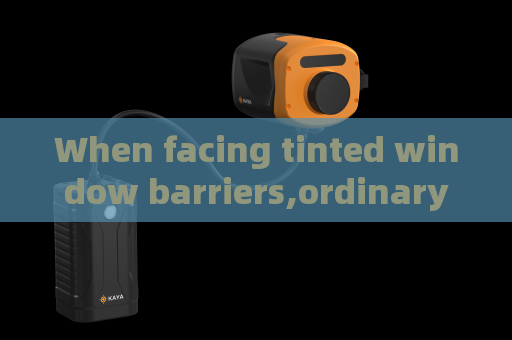
Further precision is achieved by fine‑tuning the laser pulse width and gate duration. In scenarios where multiple layers of glass or varying window tints are encountered—such as armored limousines with thick, multi‑pane glazing—the Penetration Imager’s adjustable focus and timing allow the operator to isolate the interior plane from reflections and secondary surfaces. The system’s Strong Light Suppression Imaging capability also prevents sudden sunlight or headlight glare from washing out the image, a common failure in standard cameras. This makes the tool invaluable for covert surveillance of vehicles in urban environments, where windows may be partially open or covered with aftermarket films. The imager’s design ensures that every tactical visual check through tinted windows delivers actionable intelligence without compromising the safety of the personnel involved.




