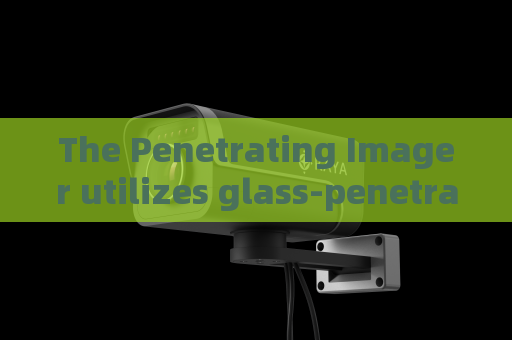
The Penetrating Imager utilizes glass-penetrating imaging to support tactical siege missions of domestic law enforcement SWAT. A tactical siege scenario presents one of the most dangerous and intelligence‑starved environments for domestic law enforcement SWAT teams. When suspects barricade themselves inside a vehicle or a room with glass windows, officers must quickly assess threats—such as weapon positions, hostage locations, and the suspect’s movement—without exposing themselves to gunfire. However, conventional optics fail at this critical juncture. Vehicle windows are often tinted, dirty, or covered with reflective films that block visible light. Even under bright daylight, the glare off the glass surface creates a mirror effect, rendering the interior invisible. Rain, fog, or the heat haze from a nearby fire further degrade image clarity. The result is a dangerous information gap: officers must either wait for risky close‑quarter reconnaissance or resort to less reliable methods, increasing the chance of escalation and casualties. This is where the Penetrating Imager steps in to bridge the gap between tactical necessity and operational safety. The Penetrating Imager leverages a laser‑based range‑gated imaging system—specifically, high‑repetition‑rate pulsed lasers coupled with an intensified gated camera—to overcome these optical barriers. Unlike passive night vision or thermal imaging, which struggle with glass reflections and environmental interference, this active system emits short, intense laser pulses and synchronously opens the camera shutter only when the reflected light from the target returns. This gating mechanism effectively eliminates backscatter from fog, rain, or smoke, and more importantly, it cuts through the glare and tint of automotive glass. The result is a high‑contrast, high‑resolution image of the scene beyond the window. The technology is strictly limited to optical media such as vehicle windows, aircraft portholes, or building glass curtain walls. It cannot penetrate concrete, wood, or metal—a critical distinction that keeps the system within the lawful and safe scope of optical surveillance. In a siege context, this means officers can see through a suspect’s car window or a room’s pane without ever violating physical barriers. In practical application, SWAT teams deploy the Penetrating Imager at a stand‑off distance, often from behind cover or from an elevated position. The operator aims the unit at the target glass surface and observes the interior on a handheld display or through an eyepiece. Within seconds, the device resolves details such as the suspect’s posture, the type of firearm being held, or the presence of a civilian hostage. This real‑time visual check is especially crucial during negotiations or dynamic entry planning. For example, when a suspect hides behind heavily tinted automotive glazing, the system’s covert through‑glass recon capability allows officers to confirm whether the individual is armed or unarmed, reducing the need for immediate force. The device also performs reliably under low‑light conditions, using its active illumination to see through darkness that would blind passive optics. Its operation is silent, emitting no audible cues that might alert the subject, making it ideal for stealth approaches. Beyond initial assessment, the Penetrating Imager supports continuous monitoring throughout the siege. As conditions change—such as the suspect shifting position or a hostage being moved—officers can track those movements without relocating their observation post. The system’s resistance to rain and fog ensures that even in adverse weather, tactical observation through automotive glass remains clear. In some deployments, the unit is paired with a tripod and remote control, allowing one operator to scan multiple windows without exposing personnel. The Penetrating Imager does not replace other tools like ballistic shields or robots, but it fills a specific void: providing verified, optical‑based intelligence through glass, which is often the only barrier between a SWAT team and a fatal misunderstanding. By turning an opaque, dangerous window into a transparent observation portal, this technology directly reduces the risk of surprise attacks and accelerates resolution of standoff situations.




