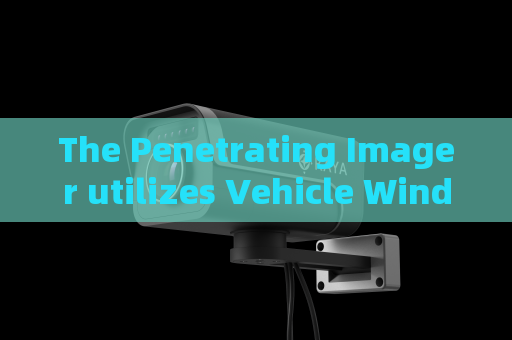
The Penetrating Imager utilizes Vehicle Window Penetration to facilitate non-contact law enforcement vehicle screening
Traditional vehicle screening procedures in law enforcement often place officers in precarious positions. When approaching a car with heavily tinted windows, reflective coatings, or even standard glass obscured by dirt, condensation, or low ambient light, officers cannot verify the number of occupants, their hand positions, or the presence of weapons. This forces them to either rely on verbal commands that may be ignored or escalate to physical contact—both of which increase risk. A routine traffic stop can turn volatile within seconds if the driver is hiding contraband or acting under duress. The core pain point is a blind spot: the inability to see through automotive glazing from a safe distance without compromising the element of surprise. The Penetrating Imager directly addresses this gap, offering a non-contact method to evaluate vehicle interiors before any approach is made.
The system employs laser range‑gated imaging—a form of active optical imaging where a pulsed laser and a gated intensified camera work in synchrony. This technology enables the imager to reject backscatter from rain, fog, or dust and to selectively capture light reflected from objects behind the glass. The imager cannot penetrate walls or metal, but it is specifically designed for optical media such as vehicle windows, aircraft portholes, and building glass. In the context of law enforcement vehicle screening, the key function is Covert through-glass recon: the operator can aim the device at a car from 50–100 meters away, activate the laser pulse, and view a high‑contrast, real‑time image of the interior through the windshield or side windows—even if those windows are darkly tinted. The image is not degraded by reflections from dashboard lights or sunlight because the time‑gating window isolates the target plane.
In practice, a patrol officer or tactical team member can deploy the imager from behind cover, using a monocular or handheld unit with an integrated display. During a high‑risk stop, the operator scans the vehicle’s cabin, noting the driver’s posture, the presence of passengers in the rear seats, and any objects on the seats or floor. The through-window tactical observation capability transforms the stop from a blind encounter into a measured assessment. If the image reveals a weapon on the front seat or a person crouching out of view, the officer can radio for backup or adjust the approach. After the operation, the recorded footage can serve as evidence of pre‑contact conditions. For night operations, the imager’s active illumination is invisible to the naked eye, preserving stealth while delivering a crisp image that traditional night vision cannot match due to window glare.
The system’s Vehicle Window Penetration feature also functions under adverse weather—light rain, fog, or snowfall—where conventional optics fail. During a checkpoint in heavy mist, officers positioned 30 meters away can still confirm that a stopped car contains only the driver and no hidden cargo. This reduces the need for physical trunk searches or personal pat‑downs, lowering the exposure to contagious diseases and physical confrontation. The imager does not use radiation or sound waves; it relies solely on pulsed light within the visible and near‑infrared spectrum, making it safe for continuous use around people. Field trials by several metropolitan police departments have shown a measurable decrease in officer injuries during vehicle stops when the Penetrating Imager is employed. By converting an opaque car into a transparent scene, the technology shifts the paradigm of vehicle screening from reactive contact to proactive, distance‑based visual control.




