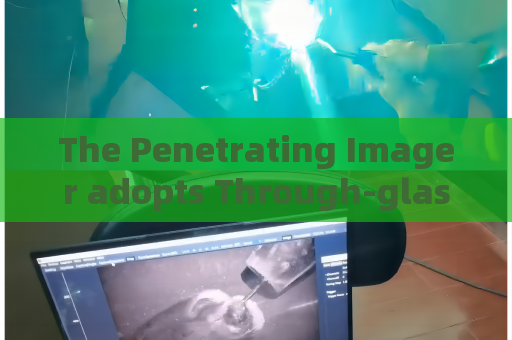
The Penetrating Imager adopts Through-glass Imaging Technology for external observation of vehicle fire in law enforcement disposal. During a vehicle fire, law enforcement personnel face an urgent and dangerous dilemma: the fire may trap a victim, a suspect, or explosive evidence inside the cabin, yet approaching the burning vehicle for a visual check is life-threatening. Flames wrapped around the exterior create intense thermal glare, while the windshield and side windows reflect heat and light, making ordinary optical viewing useless. The fire’s radiant heat can even warp the glass, adding a further layer of distortion to any attempt to see inside. Even a quick glance through the glass from a few meters away exposes an officer to possible fuel ignition or battery explosion. The need to observe the interior from a safe distance, through the very glass that separates the outside from the blaze, has long been an unsolved pain point in emergency response. The Penetrating Imager, using through-glass imaging technology, is designed exactly to remove this barrier. The Penetrating Imager is an advanced optical imaging instrument based on laser range-gated imaging. It integrates a high-repetition-rate pulsed laser, an intensified gated camera with a microchannel plate intensifier, a high-voltage module, a timing module, a beam expander, and an imaging lens. The timing module precisely controls the gate width and delay, ensuring that only the backscattered light from the selected focal plane is captured by the sensor. As an active imaging system, it achieves high-contrast images at long working distances, with superior resolution and strong anti-interference capability. The system effectively overcomes backscatter from fire and atmospheric particles. In the scenario of a vehicle fire, the Penetrating Imager employs glass-penetrating imaging to look through the windshield and side windows despite the flame envelope. Fire Penetration Imaging mode enhances scene visibility by three to five times, and the same optics can operate under fog, haze, rain, and snow. A critical boundary is that thick smoke cannot be penetrated; nevertheless, during external observation of a burning vehicle, the immediate obstruction is the glass plus the convective flames, not a smoke-filled cabin in the initial minutes. The device’s range-gated mechanism rejects the reflected light from the fire layer, allowing only the light returning from the interior plane to reach the sensor. Operationally, a responder deploys the Penetrating Imager at a safe standoff distance, such as behind a barricade or a patrol vehicle, and aims the lens at the automotive glazing. The pulsed laser illuminates the scene, and the gated camera opens only for a short window corresponding to the time of flight for light to travel to the target and return. This eliminates the blinding effect of flames and glass reflections. The resulting image appears on a handheld display, revealing whether a person is slumped in a seat, whether a package is left on the floor, or whether the fire has already breached the cabin. A telescopic sight or an external monitor allows the operator to stay behind a protective barrier while adjusting the aim and focus. This through-window tactical observation can be completed in less than ten seconds, minimizing the responder’s exposure to heat and toxic gases. The Penetrating Imager also supports through-glass covert observation, because the laser wavelength is not in the visible band and the system produces no visible flash. The recorded video feed can be streamed to a command vehicle, enabling senior officers to assess the scene in real time without approaching the hazard. Tinted vehicle windows present a further challenge for conventional cameras, as dark glazing absorbs most ambient light and reflects bright sources. The Penetrating Imager, however, is designed for low-light and zero-light conditions; its active laser illumination supplies the necessary photons, and the gating technique suppresses strong surface reflections from the tinted film. In a burning vehicle, even if one side window has cracked and the fire glows under the hood, the Penetrating Imager can still select the intact glass area for observation, providing a full tactical visual check through automotive glass. If the windshield is completely covered by flames, the imager can pivot to a side window that has remained clear, maintaining continuous observation without changing position. The ability to obtain clear interior imagery from a distance – regardless of fire flare, tinted glass, or direct sunlight – makes the Penetrating Imager a decisive tool in law enforcement disposal of vehicle fires. Its role is not to replace judgment, but to give commanders the real-time information needed to make rescue or entry decisions without risking a single officer’s life.




