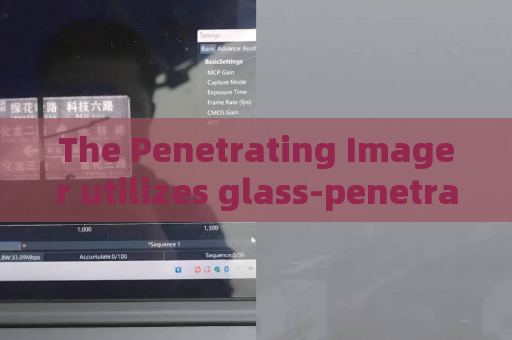
The Penetrating Imager utilizes glass-penetrating imaging to lower exposure risks during hostage rescue law enforcement operations. In a hostage rescue scenario, the first step is often the most dangerous: finding out what is happening inside a sealed room or a vehicle. A suspect may be holding a knife to a hostage’s throat, or a gun aimed at the door. Law enforcement officers cannot simply walk up to the window because any silhouette or sound can trigger a violent response. Even from a distance, ordinary optics—unlike the Penetrating Imager—fail when faced with reflective glass, aftermarket tint films, or a sharp difference between interior and exterior lighting. The glass becomes a one-way mirror that hides the threat while exposing any officer who tries to peek through it. In many incidents, the location is unpredictable—a parking lot, a suburban driveway, or a stopped sedan on a bridge. The window may be dirty, scratched, or covered in raindrops. Using flashlights or spotlights to illuminate the interior would reveal the observation position. This critical information gap forces tactical teams to make decisions based on incomplete data, risking both hostages and rescuers. The Penetrating Imager offers a way to fill that gap without stepping into the danger zone. The Penetrating Imager utilizes glass-penetrating imaging through a laser range-gated system. The device integrates a high-repetition pulsed laser, an intensifier gated camera containing an MCP image intensifier, high-voltage and timing modules, a beam expander, and an imaging lens. As an active imaging system, it transmits short laser pulses toward the target area. The camera’s gate opens only when the reflected light from the desired distance arrives, while reflections from the glass surface and scattered light from the atmosphere are rejected. The Penetrating Imager’s timing principle allows the operator to perform through-glass surveillance at a safe standoff distance. The pulse width and gate window can be precisely set to select the focal plane inside the vehicle or room, ignoring objects only a few meters away. Whether the barrier is an automotive side window, a high-speed train window, or a building’s glass curtain wall, the system isolates the scene behind it. The result is a high-contrast image with long range, high resolution, and strong resistance to environmental backscatter. It does not rely on ambient light, so it operates under any natural lighting condition. During a vehicle hostage incident, the tactical team can deploy the Penetrating Imager behind a parked car or inside a nearby building, fifty to a hundred meters away. The operator sets the range gate according to the distance to the suspect vehicle’s interior. The laser illuminates the passenger compartment through the window, and the gated camera receives only the light that has passed through the glass and bounced off the occupants. The operator sees the suspect’s hands, the hostage’s position, and any visible weapon in real time on a monitor. The live feed can be transmitted to the command post and recorded for later analysis. A tripod with a remote pan-tilt head allows the imager to be adjusted without any operator touching the device. This observation works in daytime glare, at night, and even in rain, fog, or haze because the system’s active illumination and range gating suppress backscatter. No tactical member needs to approach the glass, no reflective mirror is used, and no bright light reveals the observation post. The Penetrating Imager continuously updates the command team’s situational awareness, allowing negotiators or entry teams to adapt their strategy without exposure. The Penetrating Imager directly addresses the core risk of exposure. In a typical hostage crisis, every attempt to gain visual intelligence may cost lives. With the Penetrating Imager, law enforcement can maintain covert observation through vehicle windows for hours, tracking changes in the suspect’s behavior or the hostage’s condition. The imagery guides the precise moment for a non-negotiated entry or simply confirms that negotiation is still viable. Because the system relies only on reflected light, it cannot see through walls or other opaque barriers; its strength lies precisely in the optical medium of glass. For police departments facing vehicle-related abductions or room barricades, the glass-penetrating capability turns a transparent threat into an invisible advantage. The Penetrating Imager ensures that the hostage rescue team sees first, sees clearly, and acts decisively without ever being seen.




