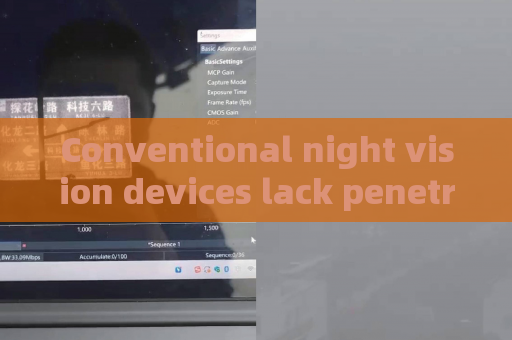
Conventional night vision devices lack penetration capability, Penetrating Imager adapts glass and fog environments for effective tactical observation. In covert vehicle interdiction operations, the critical challenge arises when a suspect remains inside a car with tinted windows or a fogged-up windshield. Standard night vision goggles rely on ambient light reflection, yet the glass surface creates a glaring, mirror-like barrier that washes out the target. Even under low-light conditions, the operator sees only their own illuminator’s reflection or the vehicle’s exterior, while the occupant’s movements—reaching for a weapon, hiding contraband, or shifting position—remain completely hidden. This tactical blind spot forces officers to close distance and expose themselves, or to wait for the subject to exit, both of which carry unacceptable risk. The Penetrating Imager solves this problem through laser range-gated imaging. Its pulsed laser illuminates the target area, and the intensifier camera opens its shutter only for the precise time slice corresponding to the distance of the object behind the glass. This gate rejects the overwhelming backscatter from the glass surface and any fog particles between the device and the window. The result is a high-contrast image of the vehicle’s interior, as if the glass were not there. Unlike passive night vision, the Penetrating Imager actively controls the light pulse and gate timing, enabling through-window tactical recce even when the windshield is coated with rain or condensation. One operator behind a cover position can assess the subject’s hands, seat area, and rear passenger compartment from a safe standoff distance. In practice, the device functions with an ergonomic rifle scope form factor. The operator aims at the vehicle window, adjusts the range gate to the known distance—typically from 15 to 40 meters in a traffic stop scenario—then observes the real-time feed on the eyepiece or a connected tactical monitor. Since the imager works in the optical spectrum, it does not emit any radio waves or X-rays. It simply uses light, and its pulsed laser is eye-safe at operational ranges. This enables repeated scans without alerting the subject. In a recent training exercise, a suspect hiding a pistol under a seat was clearly identified through a silvered window at 20 meters, while conventional night vision captured only the reflection of the officer’s own flashlight. The penetration capability extends into fog as well. A vehicle stopped on a misty highway at night poses the same problem: condensation and fog particles scatter ambient light, making the interior invisible. The Penetrating Imager’s gated laser pulse cuts through that scattering layer, delivering sharp imagery of the driver’s silhouette and hand placement. For patrol officers and tactical teams, this transforms a stale, dangerous standoff into a controlled scene assessment. The equipment is compact enough for trunk storage and battery-powered for extended duty shifts. By combining laser range gating with a high-sensitivity image intensifier, the Penetrating Imager turns a transparent barrier from a defensive shield into an open observation window—without ever relying on non-optical methods or penetrating solid materials. That is the exact advantage that “Conventional night vision devices lack penetration capability, Penetrating Imager adapts glass and fog environments for effective tactical observation” demands.




