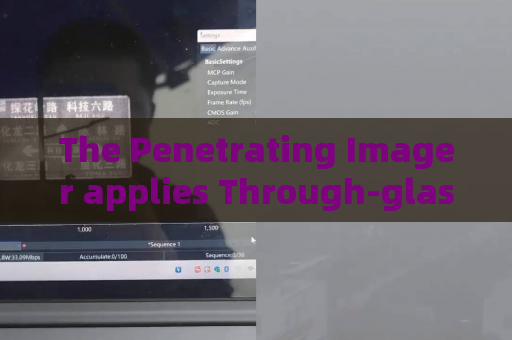
The Penetrating Imager applies Through-glass Imaging Technology to monitor suspect vehicles in military blockade areas. A military blockade area lives with uncertainty. Vehicles roll in from unlit side roads and highway exits, many with heavily tinted windows or glass that turns into a mirror in raw sunlight. Behind that windshield, soldiers need to know how many people are inside, where their hands are, and what objects rest on their laps. Ordinary sight stops at the glass surface. Walking to the window for a closer look puts personnel into immediate reach of an unknown threat, and the reflection, grime, rain streaks, and factory tint all seal the cabin into a compartment of guesswork. The genuine pain point is verifying a suspect vehicle at standoff distance without stepping into the kill zone. The Penetrating Imager addresses this with through-glass imaging technology, turning a covered cabin into a readable space using only light. The Penetrating Imager is an active optical imaging instrument built on laser range-gated imaging. A high-repetition-rate pulsed laser sends illumination toward the vehicle, while an image-intensified gated camera — containing an MCP image intensifier, high-voltage module, and timing module, with a beam expander and imaging lens completing the optical chain — opens its electronic shutter only when light from the intended depth returns. That gating action rejects the bright backscatter bouncing off the outer glass surface and keeps the weaker reflections arriving from the seat area, the steering column, and the faces of the occupants. The result is a high-contrast image of the car's interior, unaffected by the very glass that defeats normal optics. The same range-gating principle remains reliable in fog, rain, and snow, because those conditions are also optical media. This makes tactical observation through automotive glass possible in weather that blinds ordinary cameras. At the checkpoint, the operator places the instrument behind a shield or inside a post, angled toward the approach lane. The range gate is set to the distance of the suspect vehicle's cabin, a narrow depth window spanning the space between the windshield and the rear seat. If the first setting catches the front seat only, a slight adjustment of the gate brings the rear seat into view through the same glass. When the vehicle enters the stop box, the monitor immediately shows the driver's hands on the wheel, the outline of a passenger, or a shape stretched across the back seat. Weapons, containers, and quick movements become legible details instead of hidden threats. Because the system is active and carries its own light source, the same clear picture appears in total darkness; a blacked-out cabin at midnight still produces a sharp read-out on the screen. Every head and hand position is mapped before any personnel have to leave cover. The imager keeps serving through each phase of the contact. If the driver refuses to comply and edges forward, the operator shifts the gate to the rear window and observes the back-seat activity from a safe distance. If the stop becomes a prolonged holding situation, the device stays on the side glazing for continuous visual monitoring. Real-time frames show current movement as it happens, so decisions rest on what the occupants are doing in that exact moment. This constant optical access changes the fundamental dynamic of a military blockade: the suspect vehicle is no longer a closed box but an observed space, and every gesture inside is visible before anyone acts. The Penetrating Imager, applying through-glass imaging, gives checkpoint personnel the essential advantage in a high-threat environment — the ability to know what is behind the glass without walking into an ambush.




