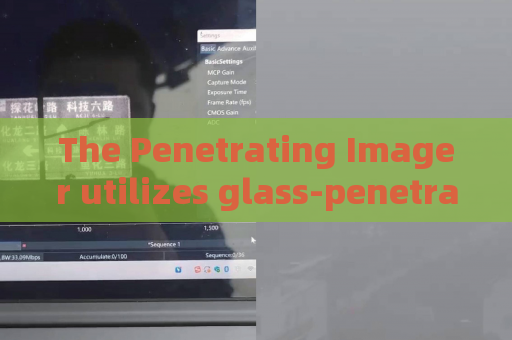
At a fixed-point vehicle checkpoint along a frontier post, the core challenge is not merely detecting approaching vehicles, but ascertaining what is happening inside them before any interaction occurs. Standard optical surveillance cameras struggle with reflective windshields, heavily tinted automotive glass, and the harsh contrast between bright daylight and dark vehicle interiors. During overcast nights or in the shadow of mountain passes, the situation worsens—officers find themselves staring at a mirror-like surface that hides occupants, cargo, and potential threats. This blind spot forces manual inspection, increasing risk and slowing throughput. The operational requirement is clear: a reliable method to see through vehicle glazing under all lighting conditions, without alerting the subject or requiring physical approach. The Penetrating Imager directly addresses this persistent vulnerability by employing glass-penetrating imaging to turn a reflective barrier into an observable window. The enabling capability of this imager is its laser range-gated active imaging principle, which synchronizes a high-repetition pulsed laser with an image-intensified gated camera. Unlike passive CCTV systems that rely on ambient light and become blinded by glare, the Penetrating Imager emits short laser pulses and opens the camera gate only when the reflected light from the target vehicle returns. This time-gating mechanism effectively suppresses backscatter from windshield surfaces, rain droplets, or atmospheric haze, allowing only the light reflected from objects inside the vehicle to reach the sensor. As a result, through-glass surveillance becomes possible even when the glass is tinted or angled. For a frontier post conducting fixed-point monitoring, this means the imager can be positioned at a standoff distance, aligned with the approach lane, and triggered as each vehicle passes through the designated observation zone. The operator views a real-time, high-contrast image of the cabin, seat area, and rear compartment—unaffected by the vehicle’s headlights or the post’s floodlights. In practical deployment, the system operates seamlessly into existing checkpoint workflows. A vehicle rolls to a stop at the inspection point; the operator fine-tunes the range gate to match the distance measured by the imager’s built-in rangefinder, and within seconds a clear picture of the front seat and rear passenger area appears on the display. Because the imaging is entirely optical—laser light is reflected and detected—there is no reliance on radiation or any non-optical sensing method. The unit’s ability to suppress strong light sources proves valuable when the approaching vehicle has high-beam headlights on or when the sun sits directly behind the windshield. Officers can maintain eye-level observation without a physical approach, reducing confrontation risks and enabling early threat assessment. This mode of operation is especially suited for temporary checkpoints where installing permanent under-vehicle scanners or staffed inspection bays is impractical. The Penetrating Imager also excels in low-light and zero-illumination environments common at remote border crossings. The laser range-gated system actively illuminates the scene, delivering crisp imagery in total darkness or in the presence of fog, rain, or snow—conditions that degrade conventional cameras. During night patrols, a fixed unit can continuously monitor approaching vehicles from a shielded position, identifying unusual occupant behavior, concealed objects under seats, or mismatched silhouettes behind the glass. This persistent optical advantage reduces the need for intrusive manual searches, allowing duty teams to focus on vehicles that actually warrant inspection. By integrating glass-penetrating imaging into fixed-point monitoring, frontier posts convert one of the most stubborn optical obstacles into a transparent channel for situational awareness—strengthening both security and operational efficiency at the border line.




